
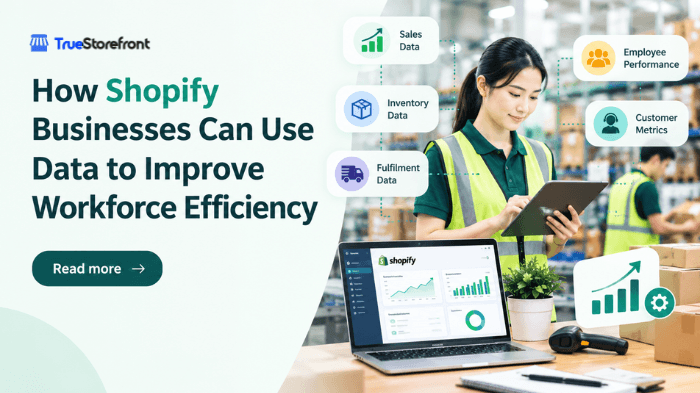
The fast development of e-commerce operations has changed the approach used by shopify businesses in managing their business processes. In the past, online retailers have been concentrating on the choice of products, digital marketing, and customer acquisition. However, as the order volumes, customer expectations, and operational complexity increased, the efficiency of the staff has started playing an important role in affecting profitability, customer experience, and scalability of the business. The employees of shopify businesses are engaged in order management, inventory management, customer service, content management, marketing operations and fulfilment coordination. The effective management of all these processes cannot be achieved through traditional supervision. It has become necessary for the businesses to obtain some workforce-related data to evaluate how their employees are contributing to the effectiveness of their operations and what should be done to increase that.
A data-based approach to workforce management helps shopify merchants to transition from reactive decision-making to proactive planning of the workforce management by analysing sales trends, fulfilment performance, workforce activities, customer service metrics, and operational costs. This approach is closely related to the fast-growing market of workforce analytics solutions.
I. Growing Importance of Workforce Data in Shopify Operations

Shopify operations produce large volumes of operational data as a result of customer transactions, order management systems, movement of inventories, and digital interactions. shopify Analytics enables merchants to access sales data, customer data, and fulfilment data via dashboards and reports. This way, businesses can track their performance trends and make necessary operational changes.
Nonetheless, workforce productivity demands the use of business data alongside employee data. For instance, an abrupt rise in orders means that there is a need for extra employees in fulfilment operations, and higher customer queries call for more support employees. Failure to analyse the data results in underestimation of staff, leading to delays in service provision, or overestimation of staff, hence unnecessary costs.
II. Data Allows Shopify Businesses to Answer Important Operational Questions, Such As:
- How many employees are required during peak demand periods?
- Which processes are creating delays?
- Where can automation reduce repetitive tasks?
III. Improving Workforce Planning Through Sales Information
Information related to sales may be considered the best source of data regarding the optimisation of your team. shopify owners can analyse past order volumes, shopping habits, results of the marketing campaigns they conducted, and customer demand to predict their future need for staff members.
As an example, a fashion shop on shopify can experience an upsurge in orders during the holiday period. It would not make sense to hire new workers only in case of any issues; instead, it can base its predictions on previous sales and prepare its team beforehand. Sales-based workforce planning makes a company more effective, as there will be a correlation between the number of available staff members and the needs of the business.
IV. Important Areas Where Sales Data Supports Workforce Decisions Include:
- Identifying peak operating hours requiring additional employee coverage.
- Forecasting staffing requirements during promotional campaigns.
- Measuring the relationship between employee availability and order completion speed.
- Understanding whether workforce expansion contributes to revenue improvement.
V. Increasing Fulfilment Efficiency by Data Analysis
Efficiency in the fulfilment of orders affects customer satisfaction in ecommerce. Customers are now demanding more speed in fulfilling their orders and also delivering their orders to the right location. There are challenges in shopify stores which are likely to affect efficiency.
Analysing the information about staff and the fulfilment process will help merchants find out where the problem lies. shopify Analytics offers businesses the possibility of reviewing various metrics of order fulfilment, including those related to order processing and delivery. For instance, when order processing becomes slower at certain hours of the day, the manager can look into staff schedules and work distribution. It turns out that more help is needed for packaging, storing, and quality control.
VI. Data-Driven Fulfilment Improvement Can Involve:
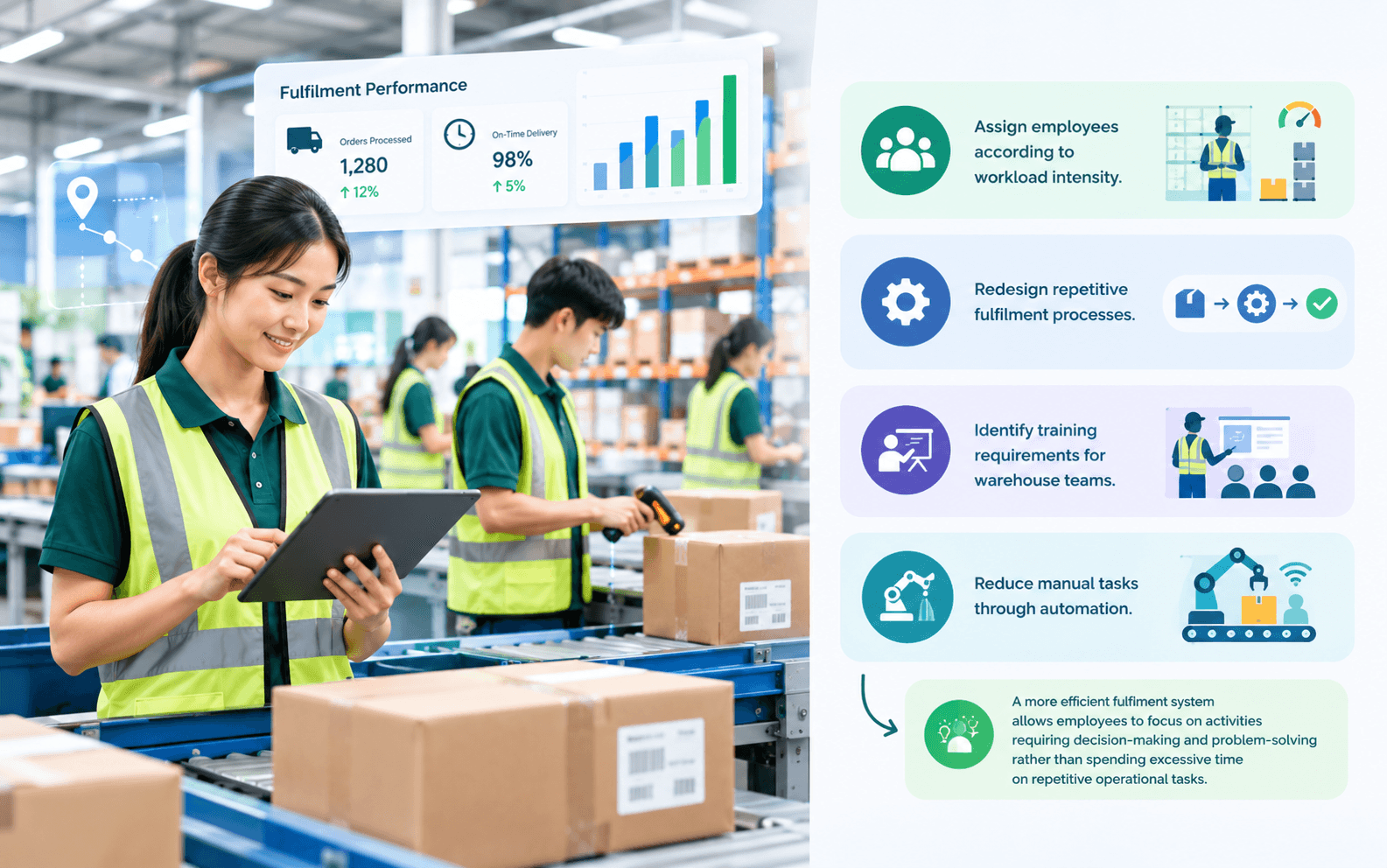
- Assigning employees according to workload intensity.
- Redesigning repetitive fulfilment processes.
- Identifying training requirements for warehouse teams.
- Reducing manual tasks through automation.
A more efficient fulfilment system allows employees to focus on activities requiring decision-making and problem-solving rather than spending excessive time on repetitive operational tasks.
V. Measurement of Employee Productivity Other Than Basic Output
Measuring the productivity of employees is one of the major uses of workforce analytics. shopify enterprises must measure productivity wisely as the value of work from each job is different. For instance, a customer care employee who deals with difficult customer complaints may deal with a smaller number of tickets compared to another who deals with 25 requests. It would be unfair to measure productivity on the basis of task completion.
The approach to workforce analytics should not only focus on the quantitative factors. There are other ways of measuring productivity, including response effectiveness, customer satisfaction, error reduction, and task completion, among others.
VII. Useful Workforce Performance Measurements Include:
- Average customer response time.
- Order processing accuracy.
- Customer satisfaction ratings.
- Revenue contribution by employee activity.
- Reduction in operational errors.
The creation of these measurement techniques is also having an impact on the workforce analytics market because firms are looking for tools that analyse productivity and improve operations.
VIII. Use of Predictive Analytics to Determine Future Workforce Needs
Use of predictive analytics can be considered one of the most sophisticated ways to make use of workforce data. Unlike traditional analytics where only past data is analysed, predictive analytics uses historical data and processes to determine future needs of the workforce. For example, a shopify business can take into consideration previous sales seasons, behaviour of the customers, and fulfilment activities in order to determine future needs of the business in terms of its workload.
IX. Predictive Workforce Planning Helps Businesses:
- Reduce emergency hiring.
- Improve employee scheduling accuracy.
- Control overtime expenses.
X. Role of Automation in Workforce Efficiency
Automation has become a more helpful technique for shopify firms that are looking to increase the efficiency of their workforce. Automation is intended to make people unnecessary, but to reduce repetitive tasks in order for them to take up other important tasks.
Some of the processes that shopify sellers may automate include stock notifications, reporting, workflows, customer communications, and order management. shopify has applications built within its environment that help to manage workflows, operations, and reports. With automation of repetitive tasks, workers have enough time for other important tasks such as relationship building with customers and product development.
XI. Examples of Workforce-Related Automation Include:
- Automated task assignment.
- AI-supported customer service assistance.
- Automatic inventory notifications.
- Digital performance dashboards.
XII. Managing Workforce Costs Through Data
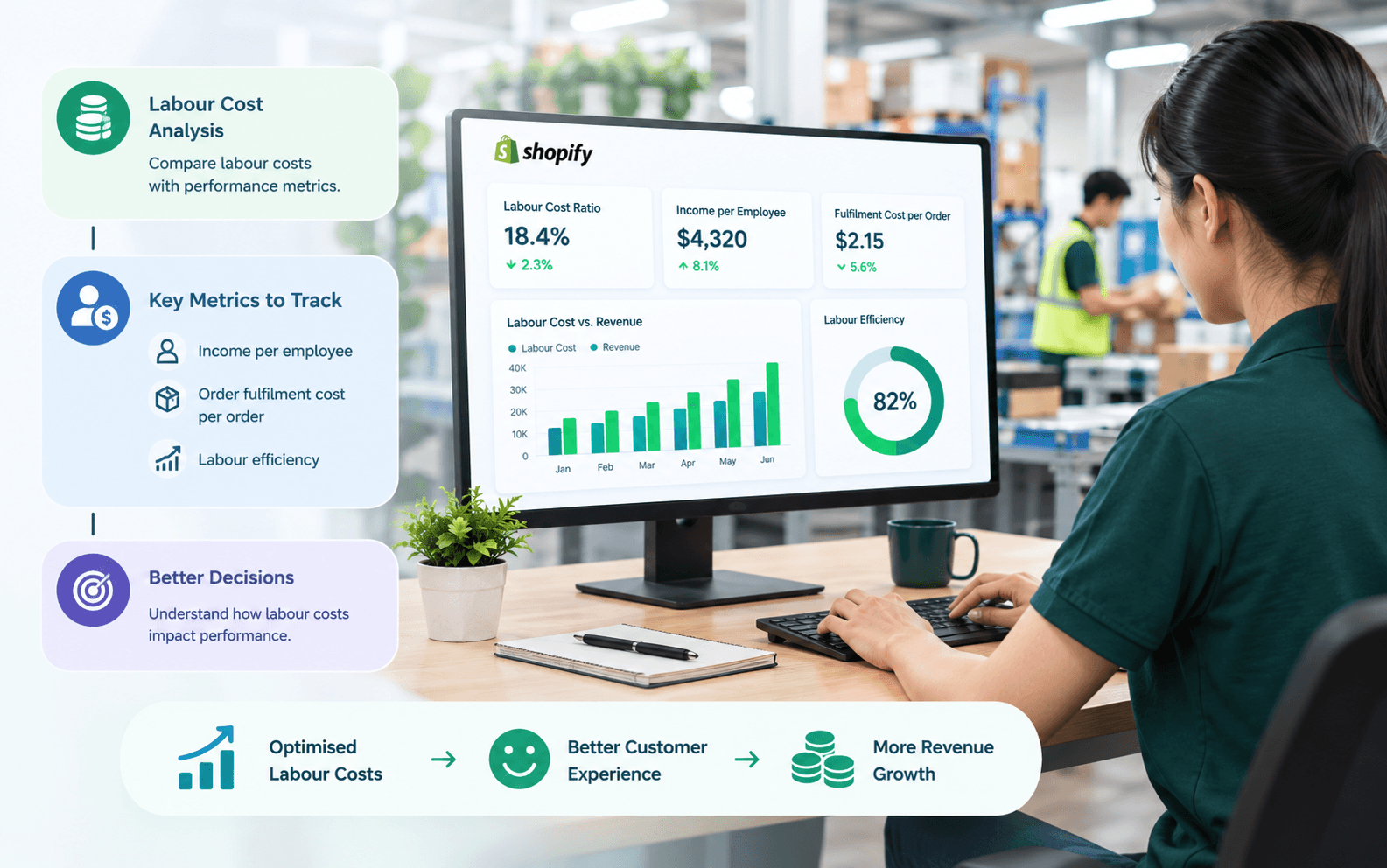
Labour costs form one of the major expenses in many ecommerce companies. Data analytics will enable shopify merchants to determine whether labour costs are in line with performance metrics. Rather than analysing labour costs through the total costs of hiring employees, companies can look at factors such as income per employee, order fulfilment cost per order, and labor efficiency.
This way, companies will get a better grasp of whether labour costs are impacting their performance. An increase in labour costs ought to reflect in better customer experience or more income generation.
XIII. Future Trends in Data-Driven Workforce Management in Shopify
The future of workforce management in shopify will revolve around the capability of translating data into insights. In line with increased complexities in running ecommerce operations, those organisations which know about workforce patterns can effectively manage their costs, productivity, and customer experience. The growing workforce analytics market indicates the emergence of intelligent workforce management solutions driven by data that allow organisations to optimize workforce allocation, operational planning, and performance.
Industry analyses, including insights provided by organisations like Pristine Market Insights indicate the increasing role of analytics in optimising workforce management. The future of shopify will involve the application of data not only for reporting but also for strategic purposes. Those shopify organisations that are able to connect workforce insights with sales analytics and operational planning will be able to build an efficient workforce.
Read more: