
Shopify analytics for omnichannel retail helps merchants understand what happens when online orders, POS sales, store pickup, fulfillment, and returns cross physical and digital locations. A Shopify store can go omnichannel well before its reporting does. The customer then exchanges a different item using Shopify POS and returns the original purchase at another store. These steps belong to one customer journey, but they are not the same event analytically.
The trouble begins when a retailer asks a simple question: How is this store doing? A physical location can generate POS sales, prepare online pickup orders, receive inventory transfers and process returns on orders it did not generate. It can perform substantial service work that never becomes an in-store sale. Forcing those activities into one channel label makes the numbers easy to read but harder to use.
Data Pivot's retail analytics consulting services can help teams define those roles before comparing locations.
Keep track of where demand started, where an order was fulfilled, where the customer collected it and where a return or exchange was processed. Connect the records when a business question requires it, while keeping the original events identifiable. The goal is a report that explains both selling performance and store workload, without counting the same purchase twice.
What you'll learn
How should a retailer compare Shopify POS and online sales without double-counting the same customer journey?
How does “buy online, pick up in store” change the way a physical store should be measured?
How should an online order be reported when the customer returns it at a different store?
Which Shopify metrics are useful for store managers, ecommerce teams and operations leaders?
When are Shopify’s native reports enough, and when does a retailer need a combined analytics layer?
What should teams reconcile before comparing stores or changing a pickup process?
Keep selling, fulfillment and service roles separate
Shopify gives merchants several ways to look at sales. Standard sales reports can be analyzed by channel, while Shopify’s retail sales reports focus on orders made at POS locations. That distinction is useful: the same business can need one view of ecommerce demand and another of in-person selling. Neither view automatically measures all the work performed by a physical store.
A store manager typically wants to understand POS net sales, orders, average order value, items per order and staff performance. Conversion also needs suitable traffic data. The ecommerce team reviews online demand, acquisition and digital merchandising. Operations follows inventory, pickup readiness and return workload. Finance needs the sales and adjustment totals to reconcile. Those views should connect, but their populations and dates are not interchangeable.
Shopify’s POS Analytics screen is available at POS Pro locations. Its retail sales reports include POS sales and exclude other sales. A retailer should therefore check the report's scope before using it to rank locations. A POS-only total can answer a selling question correctly while leaving the pickup team's contribution almost invisible.
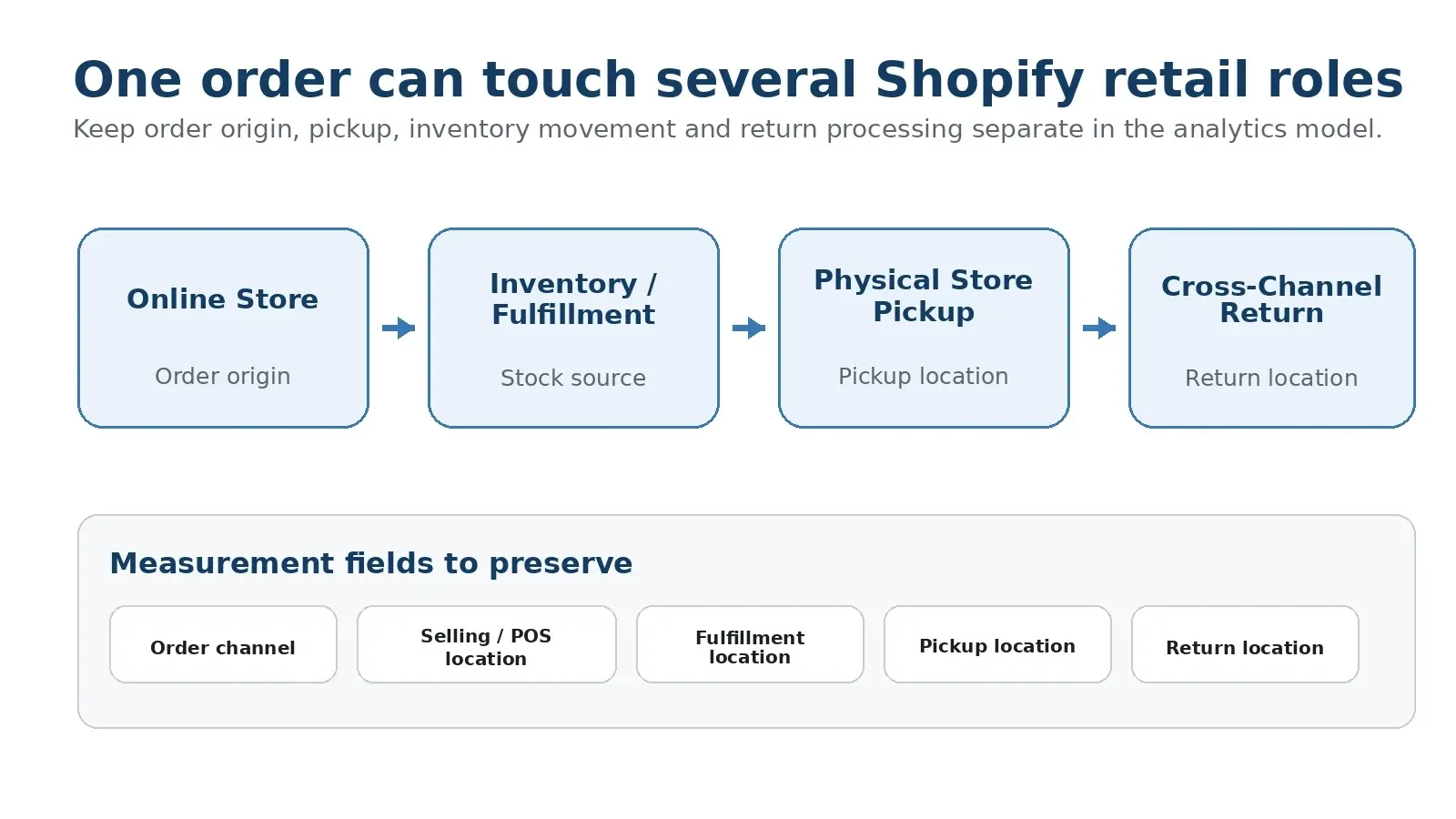
Consider an illustrative journey, not a real client case. A customer buys a lamp online, chooses Riverside for pickup, collects it there and returns it two weeks later at Midtown. The order originated online. Riverside handled the handoff; Midtown handled the return. Calling everything an online activity hides store work. Calling it a Riverside sale overstates that store's demand generation. Charging the whole return against Midtown's selling performance creates a different distortion.
Keep separate fields for order channel, selling or POS location, fulfillment location, pickup location and return-processing location. Preserve the original order and line identifiers when linking those roles. A company total should count the purchase once; location workload measures can count the different activities performed on that purchase. Those workload counts are not additional revenue.
Measure Shopify POS without misreading online demand
Shopify POS should remain a clear measure of in-person selling. Retail sales reports can break sales down by product, variant, vendor, product type, location and staff. Start with the current definitions of net sales and sales adjustments, then keep physical returned units in their own measure. A financial reversal is not sufficient evidence that an item physically came back into the store.
Shopify’s current terminology states that ordered quantity equals net quantity plus reversed quantity. Reversals can include refunds, returns, order edits and cancellations. Physically returned quantity answers a different question. Before comparing a fresh export with an older spreadsheet, confirm the field definitions rather than assuming that similarly named columns represent the same event.
TrueStorefront's guide to Shopify POS explains the platform's in-person selling context. For analytics, POS is more than a payment terminal: a transaction has a store, staff and local inventory context. Those details help managers investigate what sold and where service occurred. They should not be used to infer online marketing influence that the retailer has not actually measured.
This is where a retailer should resist the temptation to make "channel" do too much work. For a POS order, channel and selling location are closely aligned. For an online pickup order, they are not. A useful model therefore asks several questions separately: Where was the order placed? Which location fulfilled it? Which location handed it to the customer? Which location later accepted a return?
This separation improves the conversation between teams. A store can be credited for its selling performance and recognized for pickup service without being assigned the online order's revenue a second time. If a retailer wants an additional assisted-sales view, it should define the evidence and attribution rule explicitly. An assistance label is a separate managerial view, not a reason to rewrite the original sales ledger.
For example, compare a busy city location with a suburban pickup point. Their POS totals may differ, but so may their collection workload, opening hours and inventory availability. Before changing staffing, the operations manager should review activity by day and shift alongside handling time. High pickup volume alone does not reveal how many additional labor hours are needed or whether current service is poor.
Treat pickup as a fulfillment path with its own measures
Pickup in store is a visible break in traditional channel reporting. Shopify lets customers collect online purchases at eligible retail locations and supports configured store transfers for pickup. Where a transfer is involved, the location handing over the order is not necessarily the location that supplied its inventory. Check the merchant's actual setup before assuming every location can perform the same role.
From the customer's perspective, that is one purchase. From the retailer's perspective, several processes are involved: online demand, inventory availability, allocation or transfer, preparation, customer notification and physical handoff. If the order is credited entirely to ecommerce, the store's operational contribution disappears. If it is credited entirely to the pickup store, the store appears to have generated demand that actually started online.
Keep online-origin revenue with the order's originating channel, then add operational measures for the pickup location. Useful measures include pickup orders prepared, units collected, time to ready, orders requiring a transfer and canceled collections. Some require operational timestamps or exported data beyond one native report. A readiness measure needs a defined start and end event; customer collection time should not quietly become the store's preparation time.
A pickup completion rate needs an equally clear population. Compare completed pickups with eligible pickup orders from the same order cohort and allow enough time for collection. Show open and canceled orders separately, with any exclusions stated. Otherwise, a location receiving many new orders can look worse simply because customers have not arrived yet. For orders collected in parts, retain line quantities and distinguish a partial handoff from a fully collected order.
Suppose a customer places an order before a store opens. Measuring preparation from checkout can include closed hours; measuring from staff acceptance can hide an unattended queue. Choose the clock that matches the service promise, label it clearly, and retain both timestamps where possible. Compare like operating hours before describing one store as slower.
Pickup also changes the inventory question. If one location repeatedly supplies another, review item availability, replenishment timing and the promised collection location before changing allocation. A transfer count does not establish why local stock was unavailable. The inventory planner can inspect recurring product-location pairs, while the store manager investigates preparation delays. These are linked investigations with different owners, rather than one unexplained pickup score.
Separate cross-channel returns from financial adjustments
Returns need a more careful distinction than a negative sales value. Shopify's sales-reporting guidance separates sales reversals from physical returns. A reversal can affect sales reporting without proving that goods were received; refund value also needs its settlement method, because store credit is not cash. Keep the original sale, physical return, financial adjustment and inventory disposition distinct before comparing locations.
If a customer buys online and returns in a store, should the event reduce that store's selling performance?
Usually not in an origin-based management view: the store handled a service event rather than generating the original demand. Finance should still retain the actual posted adjustment. The return-processing location also matters because it may receive inventory and perform inspection or handling work. Neither attribution should erase the other.
Link each returned line to its original order context. Record where the return was processed, the quantity received, the recorded status and whether the item was restocked. Keep requested and physically received quantities distinguishable. A partial return should not reverse the full original order in a management calculation. These records support two separate questions: which sales cohorts generate return exposure, and which locations handle the resulting work?
At Midtown, receiving the lamp and making it sellable again are separate steps. A damaged item may need inspection or another disposition. Record the receiving location even when the final restock location differs, and preserve an unresolved status when the destination is unknown. Otherwise, an apparently successful return process can conceal stock that is unavailable for the next customer.
Exchanges add another event. Shopify POS supports exchanges through its return-or-exchange flow, including collection or refund of a price difference. Report the returned item, replacement item and any payment difference separately. Refund dollars alone miss an even exchange; returned units alone do not explain its economics. Do not count a replacement as a second independent customer purchase without declaring that reporting convention.
A return processed at the end of a month and a refund posted the next month can legitimately appear in different period views. Keep the service date and financial posting date visible. Finance can reconcile the adjustment ledger, while operations can observe work on the day it occurred. Moving both records into one date just to align charts can obscure the actual sequence.
TrueStorefront's discussion of Shopify's 2026 retail enhancements places local stock visibility and store returns in a broader connected-commerce context. That context supports the need to trace a journey across channels. It does not remove the need to check plan availability, workflow settings and the actual events captured in a particular merchant's store.
The National Retail Federation's 2025 research with Happy Returns describes retailers balancing returns convenience with processing costs. That is useful context for reviewing service workload, not a benchmark for an individual Shopify store or evidence that a particular return process is efficient.
Build a scorecard with clear populations and owners
A useful omnichannel scorecard gives each metric an owner and a clear next question. For Shopify retailers with physical locations, separate selling, pickup, returns and inventory context. Avoid adding these activity totals together as though they were mutually exclusive orders. The same purchase can legitimately appear once in the sales view and again in a service-workload view. This is a proposed measurement framework; some measures need additional records or custom reporting beyond native Shopify.
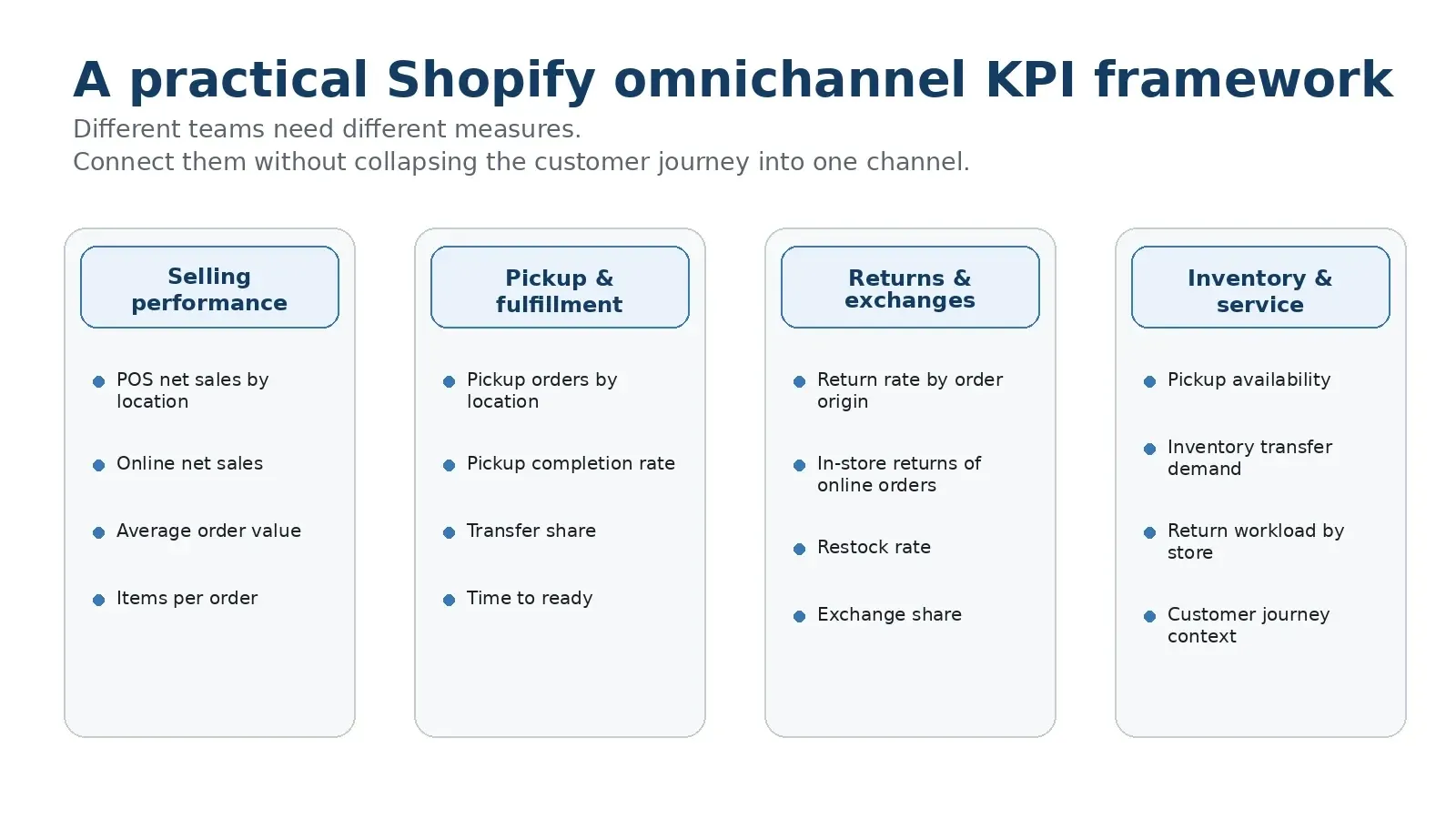
First, keep sales definitions consistent. For physical selling, review POS net sales, POS orders, average order value and items per order. For digital selling, review online net sales and online conversion using its declared session denominator. Reconcile a company sales total using consistent adjustment and date rules; do not add pickup revenue onto revenue already included in the online channel.
Second, follow pickup service by location. Track preparation time, collected units, transfer involvement and unresolved exceptions using the definitions agreed above. If a store is repeatedly late to mark orders ready, review its order queue and staffing schedule before proposing a process change. Measure any pilot against the same readiness definition, alongside cancellations or customer complaints, so speed does not come at the expense of service.
Third, distinguish returns by origin from processing workload. An original-sale unit return rate compares received or completed returned units, as explicitly defined, with eligible units sold in the same cohort. Allow the stated return window to mature and disclose unresolved requests. Processing workload instead counts return events or units handled during the operating period, including purchases made earlier. Those populations cannot be swapped simply because both measures are called returns.
Fourth, add inventory and customer context when it changes the decision. Frequent pickups and transfers may justify reviewing allocation, not an immediate stock increase. A product with substantial return exposure may need its fit information or description checked, not automatic removal. Where permitted customer identifiers are available, link them consistently; unidentified purchases must remain unidentified rather than being guessed into a customer journey.
Assign follow-up ownership before adding more KPIs. Ecommerce can review product content for a high-return cohort; store operations can examine the return queue; inventory teams can inspect restock delays. Finance should reconcile the associated adjustments. Each proposed action needs an eligible population, comparison period and success measure. None of these patterns proves that changing content, staffing or stock will improve the outcome.
Use native reports first, then connect the missing events
Shopify's native sales and retail reports are the starting point. Use their documented filters and definitions for everyday trading questions, and confirm which analytics features the merchant's plan and locations support. A separate reporting platform is useful when a decision needs information that cannot be reconciled in the available native views; its value should be demonstrated by that decision, not by the number of charts.
That need often appears when comparing online-origin pickup demand with POS selling, understanding store return workload, or joining traffic and labor records held elsewhere. Data Pivot's retail dashboard example shows how sales and store questions can be organized for management. A Shopify implementation still needs its own event definitions and source checks; another retailer's dashboard is an example of presentation, not evidence that the same measures exist in your system.
Define the question before choosing the reporting layer. Use POS sales to compare in-person selling. Add service events to compare collection and return work. Assessing what each channel retains after fulfillment and returns also needs governed cost data. Data analytics and Power BI consulting can help connect those sources, but a sales report alone cannot establish channel profitability when payment, labor or logistics costs are missing.
Preserve commerce events at their original level of detail. Keep orders and lines separate from pickup events, return lines, exchanges and posted refunds, linked through consistent identifiers. Aggregate each event set to the level required by the decision before combining results. Otherwise, joining an order to several pickup or refund records can multiply the value. Retain outside costs separately until their allocation and coverage are agreed.
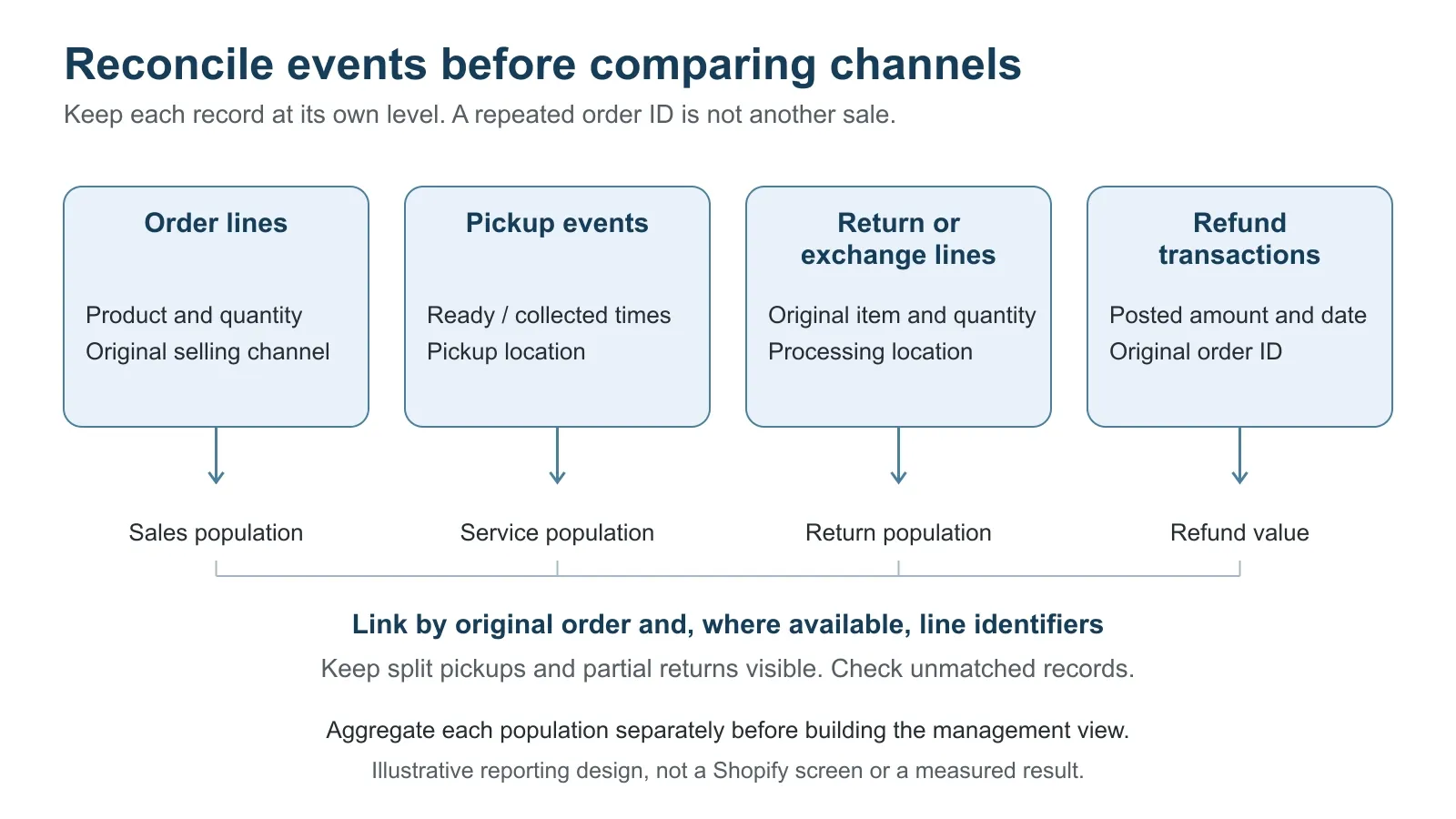
Start with a small reconciliation sample spanning a POS sale, an online pickup, a partial return and an exchange. The finance and operations owners should be able to trace each event to its source and explain its date and location attribution. Agree the refresh cutoff and show unresolved exceptions. Fixing an unmatched return or repeated order key is more useful than hiding it inside a polished company total.
Use a daily exception queue for missing pickup confirmations or unmatched return lines, and a separate periodic scorecard for trends. Assign an owner and resolution status to each exception. A sudden improvement in the scorecard should trigger a check for missing events or changed definitions before it is celebrated as better store performance.
Shopify can connect online selling and physical retail within one commerce environment. Reporting becomes more useful when it preserves the different roles inside that environment. A store's sales ranking and its service workload can both be accurate, provided readers know what each includes.
Attribute demand to where the order began, service work to where it happened, inventory movement to the locations involved, and returns to both their original sale context and processing location. Keep financial adjustments reconcilable without treating every adjustment as a physical return. Then review the measures with the people responsible for the next operational step.
The result should be a shared account of what happened and what still needs investigation. A manager can recognize a busy pickup team, examine a return cohort or question a recurring stock transfer without inflating sales or claiming an unproven cause. That is the practical test of omnichannel analytics: can the team explain the measure, trace the event and choose a sensible next action?