
On June 17, 2026, Shopify unveiled Shopify Editions Spring '26, its latest biannual product release centered around a single but transformative theme: "Everywhere." Rather than simply shipping another batch of platform improvements, Shopify introduced a new vision for commerce—one where products are no longer discovered exclusively through websites or marketplaces, but through AI assistants, conversational interfaces, retail experiences, and any digital surface where customers naturally spend their time.
With more than 150 product updates, Spring '26 represents one of Shopify's most ambitious Editions to date. The release spans AI-powered commerce, marketing automation, retail, payments, developer tools, and storefront management. More importantly, it signals Shopify's evolution from an eCommerce platform into the infrastructure powering the next generation of AI-driven shopping experiences.
I. What Is Shopify Editions?

Shopify Editions is Shopify's biannual product launch event, where the company unveils its latest innovations for merchants, developers, agencies, and enterprise brands.
Rather than publishing traditional release notes, Shopify groups new features into business-focused themes, making it easier to understand how the platform is evolving and what those changes mean for different types of businesses.
Each edition typically includes updates across:
- Online Store
- Checkout & Payments
- Shopify POS
- Marketing
- Shopify Markets
- B2B Commerce
- Shopify Functions
- Developer APIs
- AI Features
- Shopify Plus
Shopify Editions Spring 2026 is one of the platform's largest releases to date, introducing 150+ updates centered around a single vision:
Your products should be available wherever customers choose to shop—not just on your website.
II. A New Vision: Commerce Beyond the Storefront
For years, online shopping has followed a predictable journey:
Search → Website → Product Page → Checkout.
Shopify believes that journey is changing rapidly.
As generative AI becomes integrated into platforms like ChatGPT, Microsoft Copilot, Google AI Mode, and other intelligent assistants, customers increasingly expect to discover products, compare options, and even complete purchases without ever opening a traditional online store.
Instead of asking:
"Which website sells this?"
Customers are beginning to ask:
"Find me the best waterproof hiking backpack under $150."
The AI becomes the shopping interface.
Shopify's response is clear:
Wherever commerce happens next, Shopify merchants should already be there.
That philosophy drives nearly every announcement in Spring '26.
III. Shopify Catalog: The Foundation of AI Commerce
The most significant addition is Shopify Catalog.
Rather than acting as another product feed, Shopify Catalog is designed as a structured global product database containing billions of products from Shopify merchants worldwide.
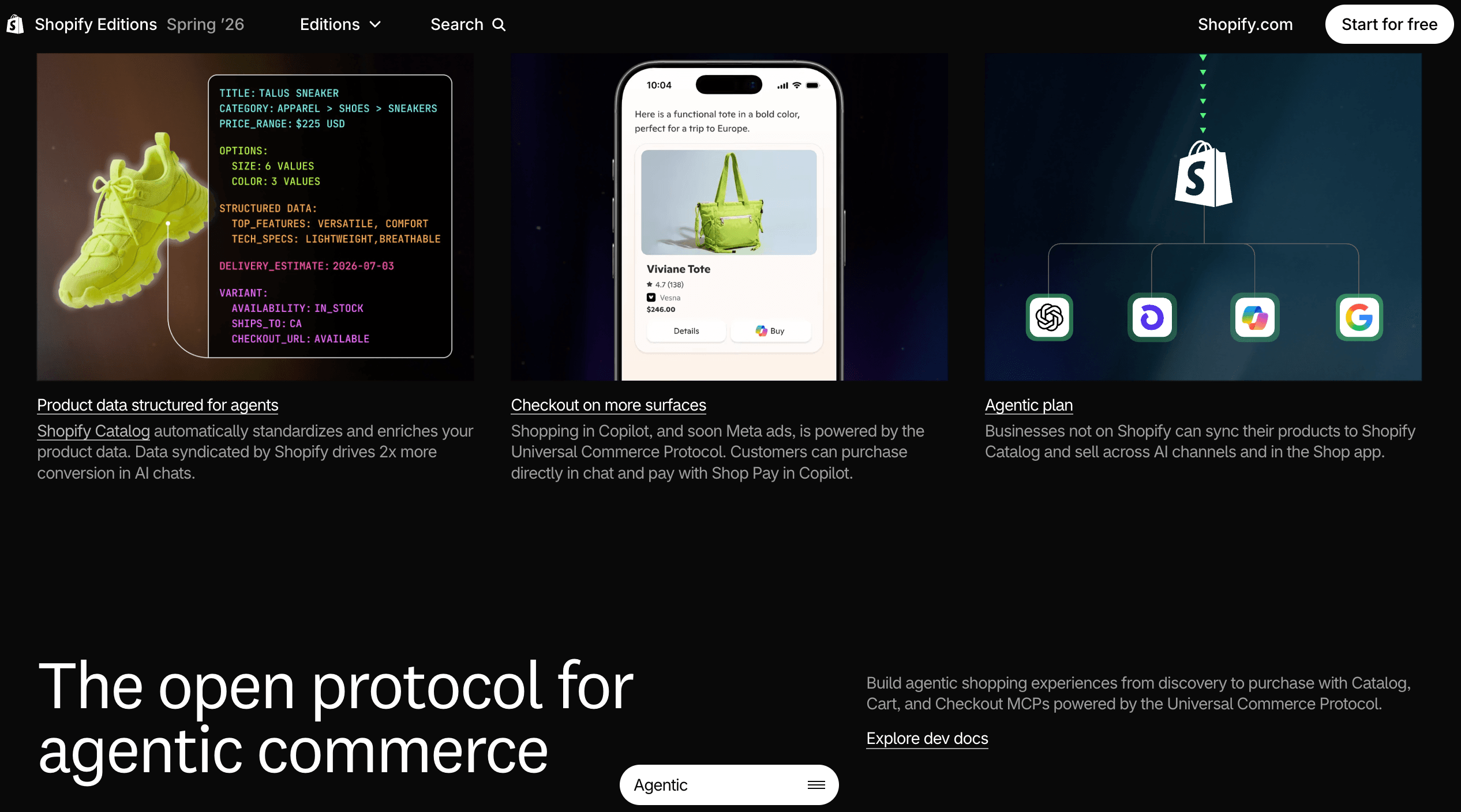
Every eligible Shopify merchant is included automatically, meaning product information is standardized and distributed across AI-powered shopping surfaces without requiring additional integrations.
This structured approach matters because AI systems perform significantly better when product information is organized consistently instead of scraped from webpages.
According to Shopify, AI searches powered by Shopify Catalog convert twice as effectively as searches relying on scraped product information because the data is cleaner, richer, and always up to date. ([Shopify][1])
New capabilities introduced in Spring '26 include:
- Personalized product discovery through Sign in with Shop
- Richer product attributes such as size, color, and variants
- Image-based product search
- Expanded Catalog APIs for developers
For merchants, this means better visibility across AI-powered shopping experiences without manually maintaining multiple product feeds.
IV. Universal Commerce Protocol (UCP): Giving AI a Common Language
If Shopify Catalog provides structured product data, the Universal Commerce Protocol (UCP) provides the language AI systems use to transact.
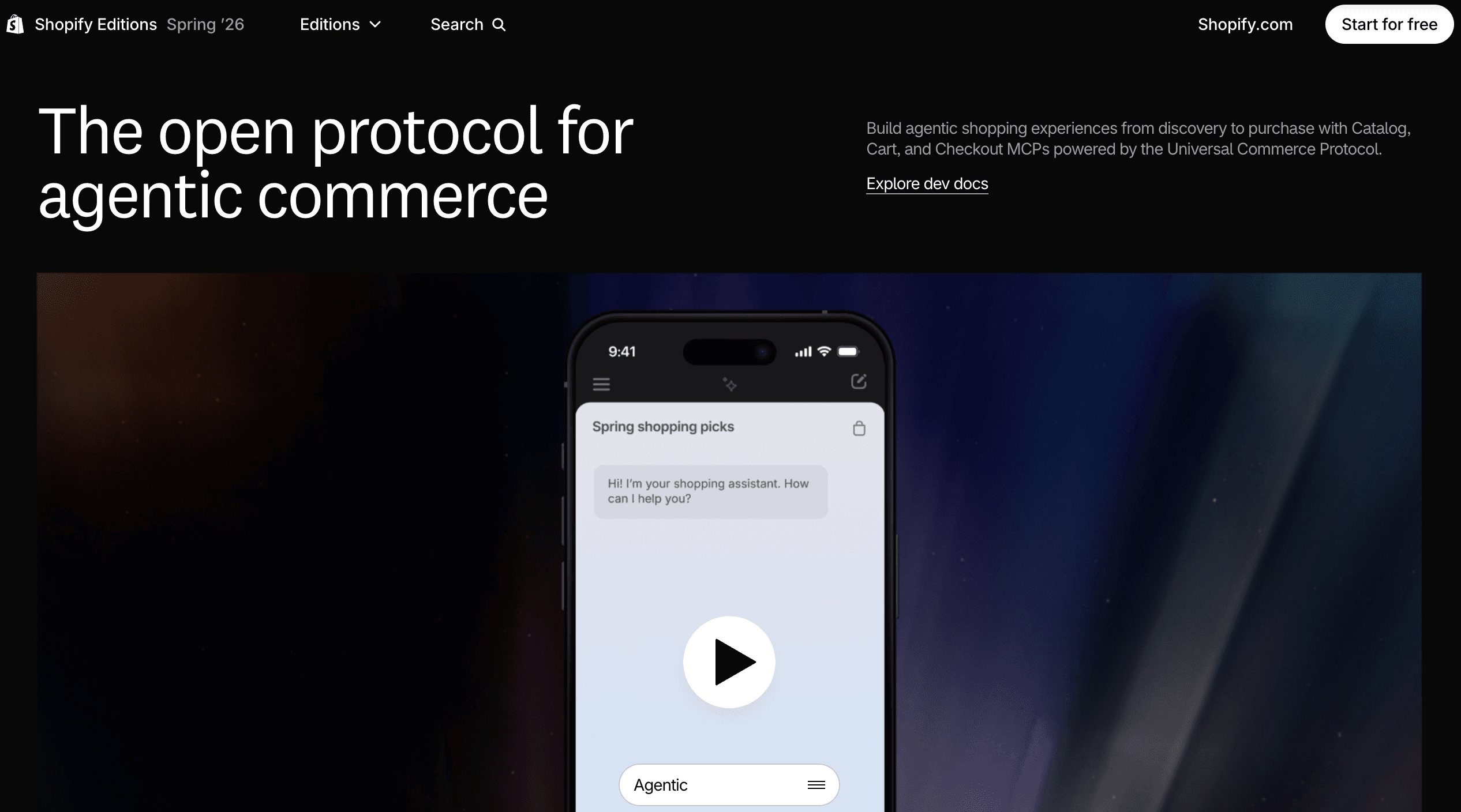 Developed alongside Google, UCP is an open standard that enables AI assistants, applications, and commerce platforms to communicate consistently throughout the shopping journey—from product discovery to checkout.
Instead of every AI platform building custom integrations with every commerce provider, UCP standardizes interactions so merchants' pricing, inventory, discounts, checkout rules, and customization remain accurate regardless of where purchases begin.
For Shopify merchants, UCP is enabled automatically.
For developers, it creates an entirely new ecosystem where AI shopping experiences can be built much faster.
This is arguably Shopify's biggest strategic investment in the future of agentic commerce.
V. Agentic Storefronts: Managing AI Sales Channels from One Dashboard
 As products become available across multiple AI platforms, merchants need visibility into performance.
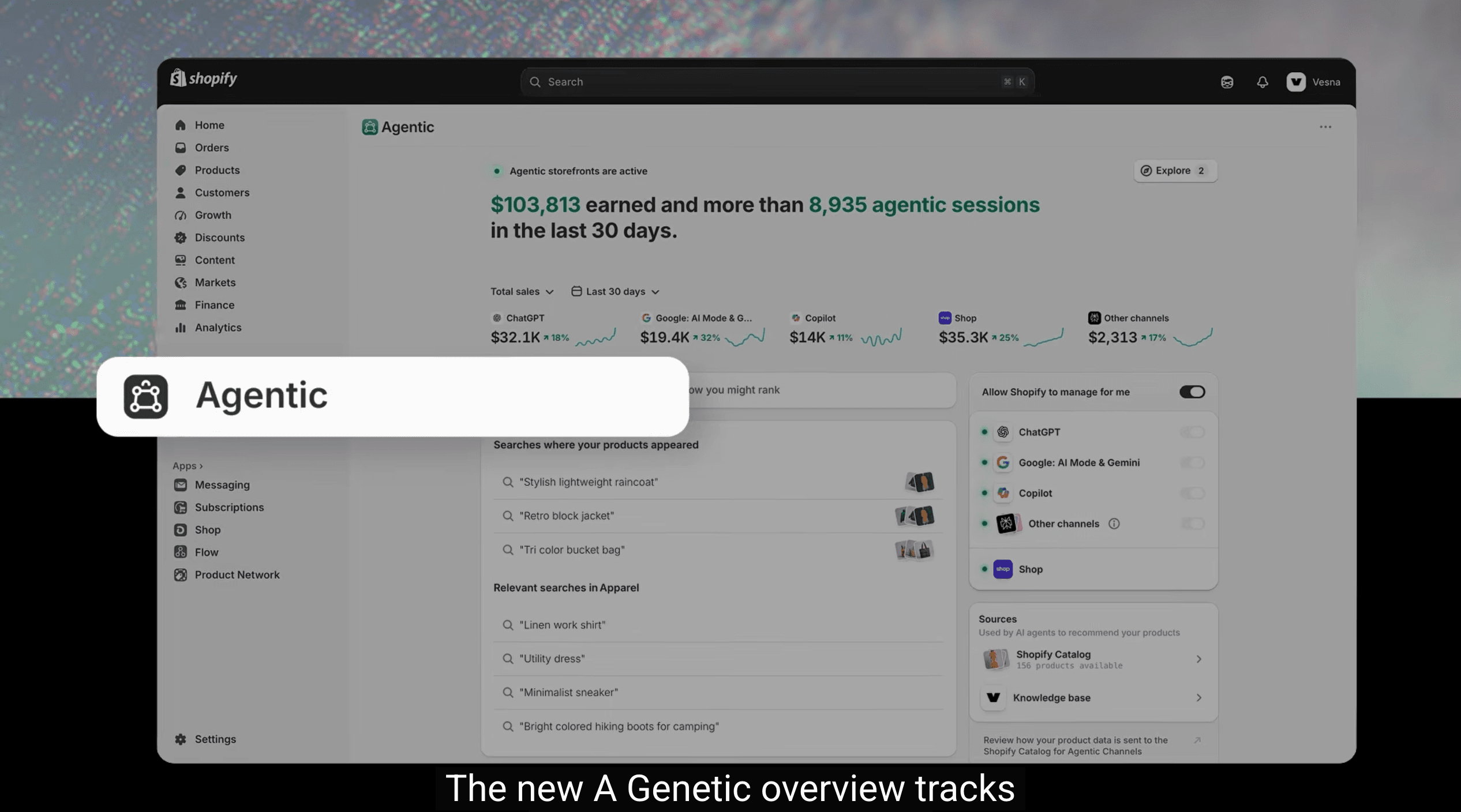
Spring '26 introduces Agentic Storefronts inside Shopify Admin—a centralized dashboard for managing AI commerce.
Merchants can now:
- Enable or disable AI shopping channels
- Monitor sales generated from ChatGPT, Microsoft Copilot, Google AI Mode, Gemini, Shop App, and other supported platforms
- View AI search queries where their products appeared
- Analyze conversion performance by channel
- Receive optimization recommendations for products that appear in AI conversations but fail to convert
Instead of treating AI traffic as another referral source inside analytics, Shopify positions AI as an entirely new sales channel deserving dedicated management tools.
VI. Sidekick Evolves into an AI Business Assistant
When Shopify introduced Sidekick, it primarily functioned as an AI assistant capable of answering merchant questions.
Spring '26 dramatically expands its capabilities.
Sidekick App Extensions
Sidekick can now connect directly with third-party Shopify apps, allowing merchants to ask natural language questions across multiple business tools.
Launch partners include:
- Klaviyo
- Loop
- Smile
- and over 15 additional integrations
For example, merchants can ask:
"Which email campaign generated the highest revenue this month?"
without opening their email marketing platform.
Sidekick Pulse
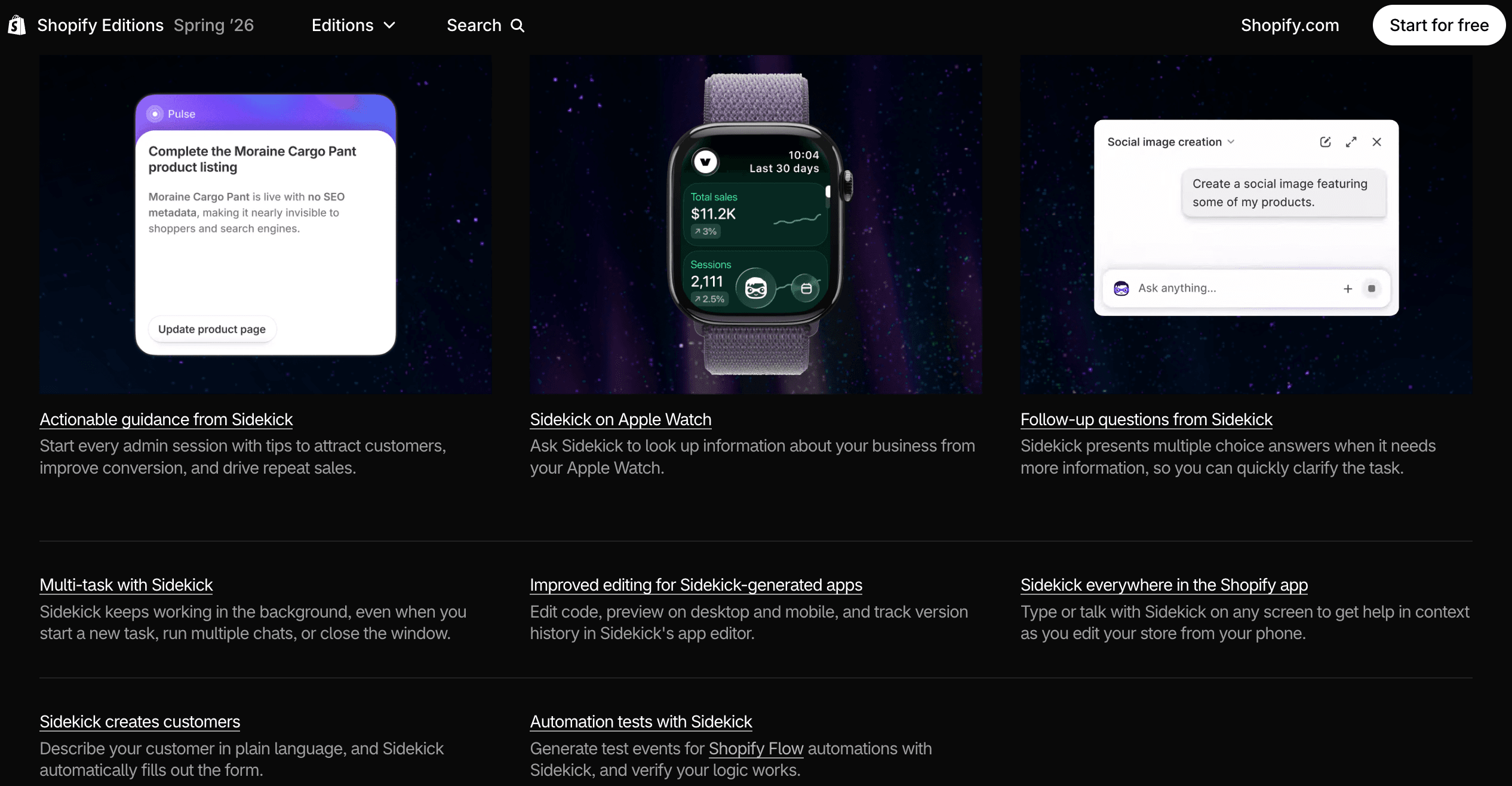
Instead of waiting for prompts, Sidekick Pulse proactively surfaces recommendations based on:
- Sales trends
- Inventory levels
- Customer behavior
- Marketing performance
This effectively transforms Sidekick into an AI operations manager rather than simply a chatbot.
Available Everywhere
Sidekick is now integrated across:
- Shopify Admin
- Mobile App
- Voice interface
- Apple Watch
Merchants can check business performance or make store changes wherever they are.
VII. AI-Powered Marketing Gets Smarter
Marketing remains one of the biggest challenges for merchants.
Spring '26 introduces several AI-powered tools designed to automate campaign creation, optimization, and customer engagement.
Campaign Autopilot
Campaign Autopilot automatically creates and optimizes campaigns across:
- Shop
Merchants simply define budgets and performance goals while Shopify's AI continuously improves campaign performance.
Future integrations will expand to Microsoft Advertising, ChatGPT Ads, and Snapchat.
AI Sales Associate
Shopify Inbox now includes an AI sales assistant capable of:
- Answering customer questions
- Recommending products
- Handling order inquiries
- Personalizing responses using Shop customer profiles
Human agents can still step into conversations whenever necessary, providing a hybrid support experience.
Expanded Shop Campaigns
Shop Campaigns now reaches customers across:
- Shop
- Meta
- Microsoft
- ChatGPT
- Open web advertising
Merchants only pay when conversions occur, making the platform increasingly performance-driven.
VIII. Native A/B Testing with Shopify Rollouts
One of the most requested features from Shopify merchants is finally here: native A/B testing, built directly into Shopify through Rollouts.
Previously, merchants often relied on third-party tools like Shoplift, Convert, Intelligems, or Google Optimize alternatives to test changes to their storefront. With Spring '26, Shopify enables merchants to experiment without leaving the Shopify Admin.
Rollouts allows merchants to:
- Schedule a new theme or checkout to launch automatically.
- Gradually release changes to a percentage of visitors.
- Run server-side A/B tests on themes, checkout configurations, and customer account experiences.
- Automatically roll back temporary campaigns after they end.
- Target experiments by market for localized experiences.
Because Rollouts is integrated natively into Shopify, merchants can validate design changes, promotions, and checkout optimizations without adding third-party scripts that may impact page performance. Shopify positions this as making experimentation a core part of running an online store rather than an advanced capability reserved for enterprise merchants.
IX. Shop App Becomes a Unified Commerce Identity
Shopify also continues expanding the Shop ecosystem.
Several notable updates include:
Shop Pay Everywhere
Shop Pay can now be integrated into non-Shopify websites, extending Shopify's payment ecosystem beyond its own merchants.
Conversational Search
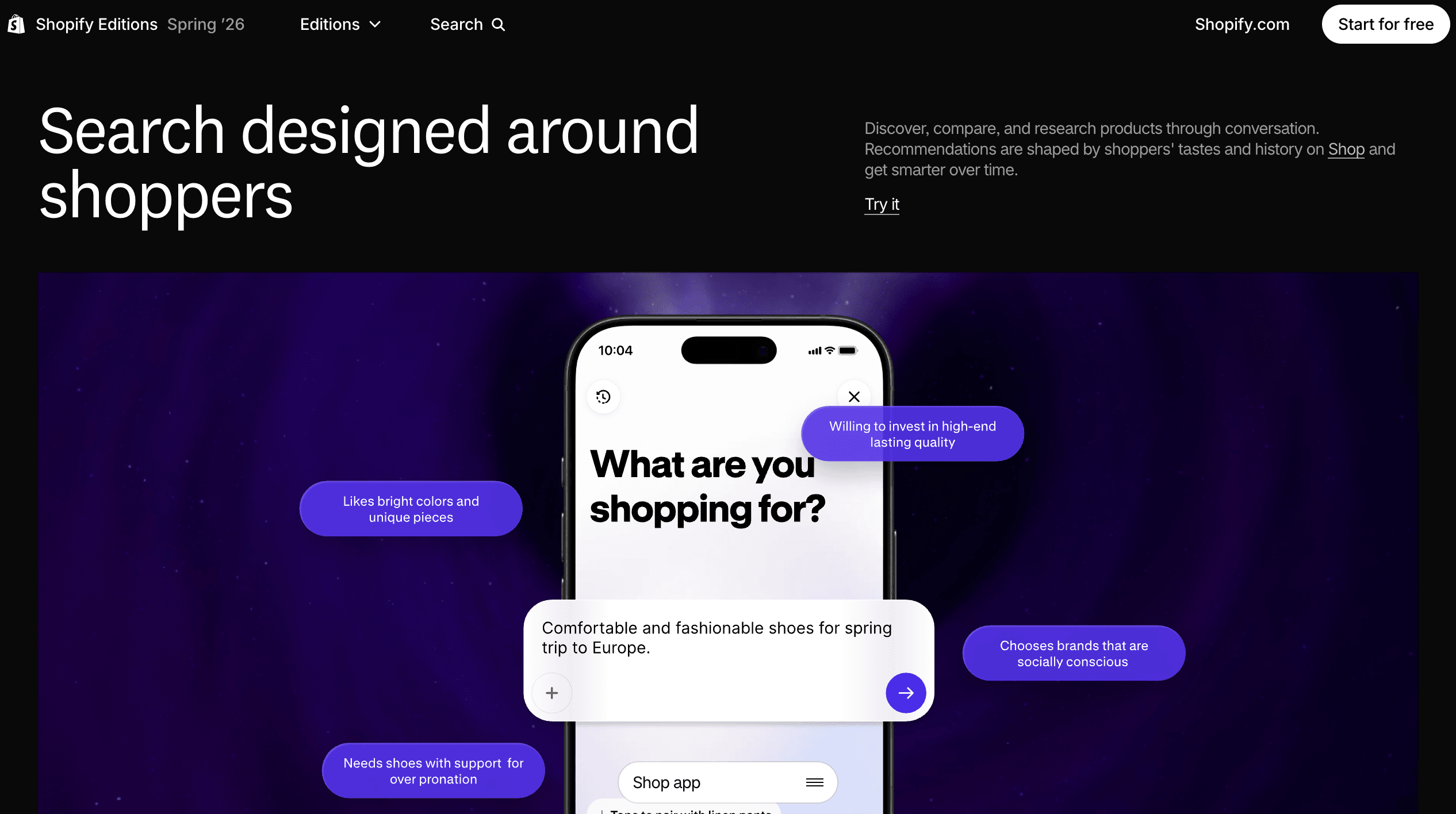
Customers can search naturally inside Shop using prompts like:
"I need comfortable running shoes for marathon training."
AI interprets intent rather than keywords.
Sign in with Shop
Developers can integrate Shopify's customer identity into external applications, enabling personalized experiences across different shopping surfaces.
X. Retail and POS Improvements
Physical retail receives significant attention in Spring '26.
Highlights include:
- POS v11 with faster cart management
- Persistent shopping carts during checkout
- Improved discount workflows
- Local inventory visibility inside Shop App
- QR-code powered in-store returns
- New Verifone Victa mobile hardware supporting barcode scanning and payment acceptance
These improvements continue Shopify's strategy of unifying online and offline commerce into one operational platform.
XI. What Developers Gain
Developers receive one of the strongest Editions in recent years.
Important additions include:
- Expanded Catalog APIs
- Public UCP implementation
- Image search APIs
- Richer product attributes
- Agentic commerce tooling
- Improved extensibility for AI-powered applications
Rather than focusing solely on storefront customization, Shopify now encourages developers to build entirely new AI shopping experiences.
XII. What This Means for Merchants
The technology announcements are impressive, but the business implications matter even more.
Merchants should begin preparing by:
- Improving product titles and descriptions
- Completing structured product attributes
- Using high-quality product imagery
- Optimizing inventory accuracy
- Monitoring AI traffic separately from traditional SEO
- Experimenting with Sidekick workflows
- Preparing for AI-driven discovery rather than relying exclusively on search engines
As AI assistants increasingly influence purchase decisions, structured product information becomes just as important as traditional SEO.
Final Thoughts
Shopify Editions Spring '26 is far more than another collection of platform updates.
It marks Shopify's transition toward agentic commerce, where AI systems actively help customers discover, evaluate, and purchase products across countless digital experiences.
Rather than forcing merchants to adapt individually to every new AI platform, Shopify is building the infrastructure that connects products to wherever commerce happens.
For merchants, the message is simple:
- Keep product data structured.
- Embrace AI-assisted operations.
- Think beyond the traditional online store.
The future of commerce is no longer confined to websites—it is distributed across conversations, assistants, apps, and intelligent interfaces.
With Spring '26, Shopify aims to ensure that wherever customers choose to shop next, Shopify merchants will already be there.