
Table of contents
Why the Payment Gateway Decision Matters for Indian Shopify Stores
What to Look for in a Payment Gateway for Your Shopify Store
6 Payment Gateways to Consider for Your Shopify Store in India
Mistakes Founders Make When Picking a Shopify Payment Gateway
Which Payment Gateway Should You Choose for Your Shopify Store?
A Simple Way to Make the Final Decision
After spending weeks on your Shopify store, you have finally reached the stage where the product photos are sharp, the pricing is sorted, and the first ads are live. But when everything is running smoothly, the orders suddenly trickle in slower than the traffic suggests they should.
More often than shop owners realize, the issue isn't the product or the ads. It's a checkout where a payment fails, a UPI request times out, or a customer can't find the way they want to pay.
Choosing a payment gateway for your Shopify store might feel like a one-time setup task. But the gateway shapes how much of your demand turns into actual revenue, how quickly you receive payments, and how easily you handle refunds.
This guide covers what Indian Shopify merchants should look for, six payment gateways worth considering, and how to make the right decision for your business.
Why the Payment Gateway Decision Matters for Indian Shopify Stores
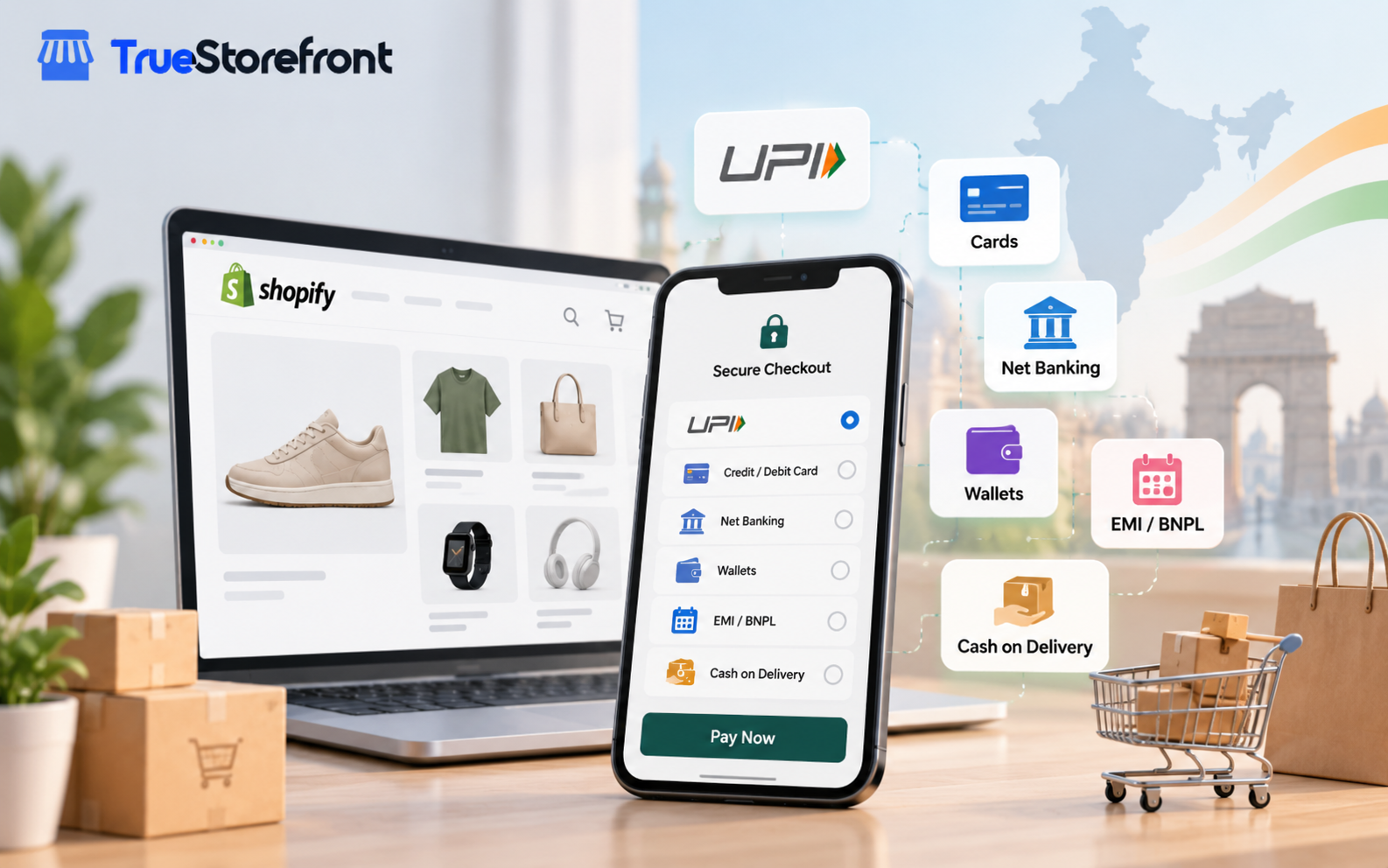
Shopify gives you a clean storefront, and with minimal steps, you can launch your own store. However, Shopify Payments is not currently available to India-based merchants, so accepting online payments generally requires integrating a supported third-party provider.
That gateway influences several important aspects of your business:
Which payment methods your customers can use
How reliably transactions are processed
How quickly refunds are initiated
When your payment settlements reach your bank account
How easily your team can reconcile payments with Shopify orders
Indian shopping behaviour also has some distinct characteristics. UPI is a preferred payment method for many buyers, while credit and debit cards remain important for larger purchases. Wallets, EMI, and buy-now-pay-later options can matter depending on the audience and product category.
Cash on Delivery (COD) is also an important consideration, particularly in fashion, beauty, and home goods, where first-time buyers may prefer paying after delivery.
If your checkout doesn't account for these preferences, you may lose orders even after successfully bringing customers to your website.
What to Look for in a Payment Gateway for Your Shopify Store
Before comparing providers, evaluate them against these seven criteria.
Time to go live: How long will it take from signup to your first live payment? Some gateways offer quick integration, but final activation depends on documentation, business verification, and merchant category. Ask for a realistic timeline.
Payment method coverage: Does the gateway support UPI, credit cards, debit cards, net banking, wallets, and relevant EMI options? Verify which methods are actually available through its Shopify integration.
Payment success rates: Look beyond advertised averages. Ask about UPI and card performance, declined transactions, and how the provider handles banking or network issues. Test actual customer payment journeys wherever possible.
COD and RTO handling: If COD accounts for a large share of orders, return-to-origin (RTO) costs can eat into your margins. Look for compatible checkout or risk-management tools that identify potentially risky orders, verify COD requests, or encourage prepaid payments.
Refund process: Check whether refunds can be initiated directly from Shopify, how payment statuses are updated, and how long customers typically wait for their money.
Settlement timelines: Find out whether the provider offers T+1, T+2, or other settlement schedules. For a growing Shopify business, predictable cash flow matters as much as transaction fees.
Support quality: When a payment problem occurs during a sale, you need a support team that can investigate it quickly. Check available support channels, escalation procedures, and whether dedicated assistance is included in your plan.
6 Payment Gateways to Consider for Your Shopify Store in India
Several payment gateways support Shopify merchants in India, but they differ in payment coverage, settlement options, checkout tools, and pricing.
Payment gateway | Best suited for | Main consideration |
Cashfree | Growing Shopify and D2C businesses | Broad payment coverage, settlement options, and COD/RTO tools |
Razorpay | Businesses seeking a broad payment and checkout ecosystem | Checkout optimization and additional commerce products |
PayU | Merchants prioritizing payment options and Shopify-native features | Onsite card payments, refunds, and affordability tools |
PhonePe Payment Gateway | Stores with a UPI-heavy customer base | UPI-focused payment experience and checkout options |
Paytm Payment Gateway | Merchants seeking familiar Indian payment options | Wallet, UPI, card, and EMI coverage |
CCAvenue | Businesses with varied domestic and international payment requirements | Multiple payment modes and currency support |
1. Cashfree: Best for Growing Shopify Stores
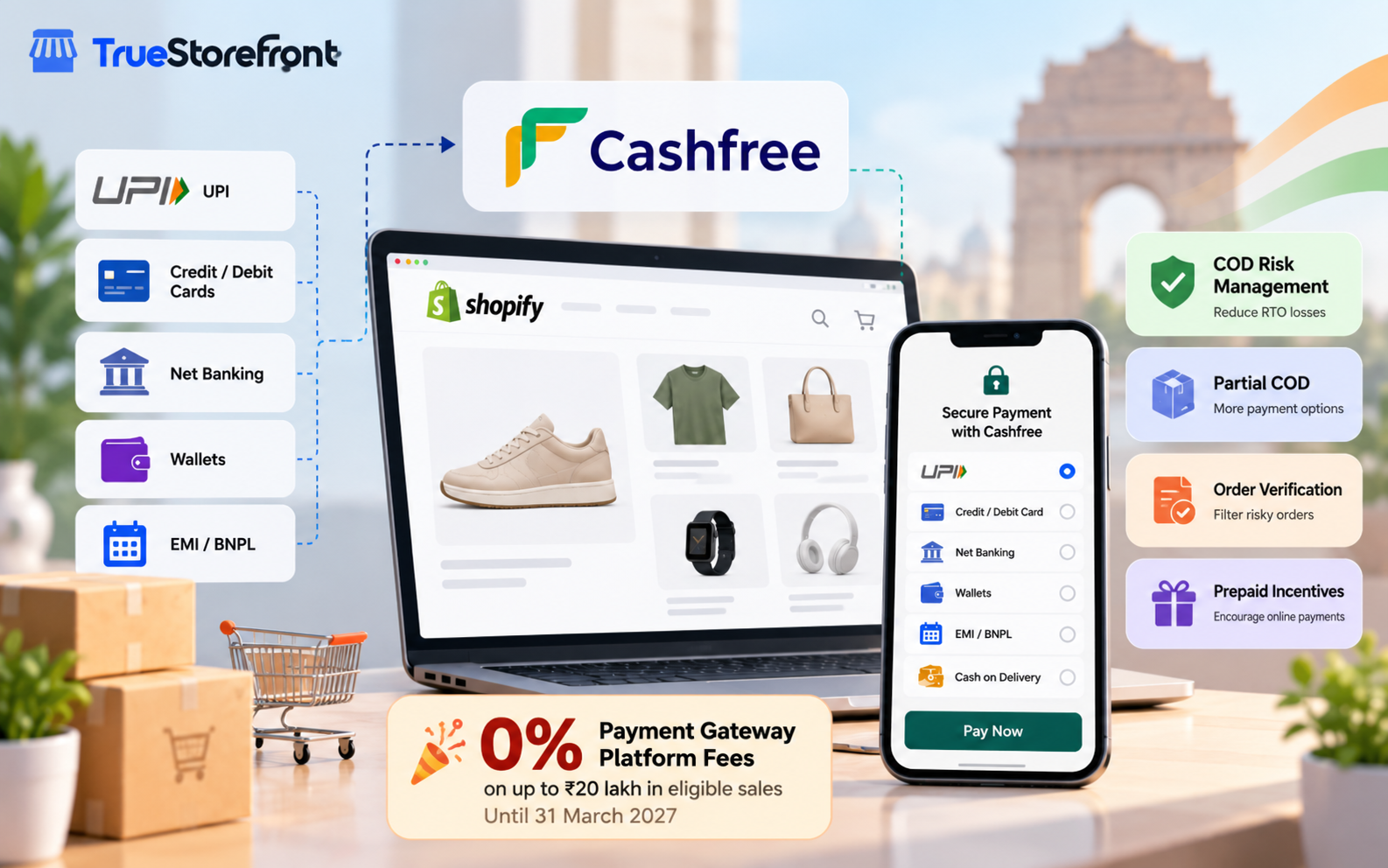
Cashfree is a strong starting point for Indian Shopify merchants who want more than basic payment collection.
Its Shopify integration supports popular payment methods, including UPI, cards, net banking, wallets, and EMI options. This helps merchants serve customers with different payment preferences without requiring separate integrations for every method.
One significant advantage is Cashfree's current festive offer: 0% payment gateway platform fees on up to ₹20 lakh in eligible sales for qualifying new merchants, available until 31 March 2027. After the offer ends or its applicable limit is reached, the standard domestic platform fee of 1.95% plus taxes applies.
For D2C businesses, another advantage is access to additional checkout and COD/RTO management tools. These include risk-based COD controls, partial COD, order verification, and incentives that encourage customers to choose prepaid payments. Such features can be particularly relevant for brands spending heavily on customer acquisition while trying to control delivery losses.
Cashfree also supports international payment acceptance, making it worth considering for Shopify sellers planning to expand beyond India.
Why shortlist Cashfree? Its combination of Shopify integration, payment optimization, settlement flexibility, and optional COD/RTO management tools makes it a practical default choice for growing Indian D2C stores.
The main thing to verify is which features are included with the standard payment gateway and which require separate activation, eligibility, or additional charges.
2. Razorpay: For Businesses Seeking a Broader Payment Ecosystem
Razorpay is another established option for Shopify merchants in India. It supports commonly used Indian payment methods and provides a range of payment and checkout products.
Alongside its standard payment gateway, Razorpay offers features focused on checkout optimization, payment analytics, and COD risk management. These may appeal to merchants who want payment processing and additional commerce capabilities within one provider ecosystem.
Razorpay is worth evaluating if you expect to use several payment-related products as your business grows.
Before selecting it, compare the total cost of the required features and check whether the checkout products you want are available for your Shopify plan and merchant account.
3. PayU: For Shopify Merchants Seeking Payment Flexibility
PayU provides a dedicated Shopify integration with support for UPI, cards, net banking, wallets, and additional payment options.
One useful feature is the ability to manage payment refunds from the Shopify dashboard. PayU also offers onsite card payment capabilities and affordability tools that can help shoppers discover eligible offers or payment plans.
This makes PayU worth considering for merchants selling products where payment convenience and affordability influence purchasing decisions.
Check its current transaction pricing, refund capabilities, and eligibility for onsite payment features before deciding.
4. PhonePe Payment Gateway: For UPI-Focused Online Stores
PhonePe Payment Gateway is worth considering for Shopify merchants whose customers frequently use UPI.
Along with UPI, it supports credit and debit cards, net banking, and other supported payment methods. PhonePe also offers checkout solutions designed to reduce friction during payment.
Its payment gateway supports Shopify integration, making it a relevant option for businesses that want a familiar payment ecosystem for Indian customers.
For merchants with a high UPI transaction share, PhonePe deserves a place on the shortlist. However, merchants should compare its card acceptance, refund workflows, settlement terms, and total charges alongside its UPI capabilities.
5. Paytm Payment Gateway: For Multiple Indian Payment Options
Paytm Payment Gateway provides Shopify integration with support for UPI, cards, net banking, Paytm Wallet, and other eligible payment options.
Its payment offering includes affordability features such as EMI and eligible postpaid payment methods, which may be relevant for merchants selling higher-value products.
Paytm also provides payment management and refund capabilities for Shopify sellers.
It is a reasonable option to evaluate if your target customers already use multiple services within the Paytm ecosystem. Confirm the availability of specific payment methods, current fees, and settlement terms before integration.
6. CCAvenue: For Businesses Requiring Broad Payment Coverage
CCAvenue is an established Indian payment gateway that supports a wide range of domestic payment methods, including cards, net banking, UPI, wallets, and EMI.
It also provides international payment acceptance and multiple-currency processing, making it relevant for Shopify businesses serving domestic and overseas customers.
CCAvenue offers reporting, settlement visibility, and customizable payment experiences.
The main consideration is pricing. Merchants should examine payment-method-specific charges, Shopify-related plugin fees, and any applicable setup or account costs before choosing a plan.
Mistakes Founders Make When Picking a Shopify Payment Gateway
Choosing a gateway based on headline fees alone is one of the most common mistakes. A slightly lower transaction rate means little if more payments fail or refunds create additional support work.
Here are four other mistakes worth avoiding.
Testing only the happy path: Everything works when you place a test order on fast Wi-Fi using a card that always succeeds. Try UPI on a slower mobile connection, simulate unsuccessful payments, and check how Shopify records the order status. Also initiate a refund and examine how the status is communicated to the customer.
Ignoring Shopify's own costs: Shopify may charge third-party transaction fees depending on your subscription plan. These are separate from the gateway's processing charges. Review both before calculating your real cost per order.
Setting up and forgetting: A gateway that comfortably handles 20 orders a week still needs monitoring when your store grows to hundreds of daily transactions. Review payment success rates, settlement delays, and failures by method as your order volume increases.
Treating COD as a separate problem: COD, RTO, customer verification, and prepaid checkout conversion are connected. A payment gateway alone does not manage the entire COD fulfilment process, so check whether compatible tools can help reduce manual work and prevent avoidable losses.
Which Payment Gateway Should You Choose for Your Shopify Store?
There isn't one payment gateway that is automatically the best for every merchant. The right choice depends on your payment mix, order volume, product category, and operating costs.
For a typical growing Indian Shopify or D2C business, Cashfree would be our recommended starting point. It addresses several needs that matter as a store scales: payment method coverage, transaction optimization, settlement flexibility, and access to COD/RTO management tools.
However, there are situations where another provider deserves consideration. PhonePe may suit a UPI-heavy business, PayU may appeal to merchants looking for specific onsite card and refund features, while Razorpay offers a broad ecosystem of payment and checkout products. Paytm and CCAvenue are also worth evaluating based on your customers' preferred payment methods.
Rather than choosing solely from a provider's marketing claims, compare the actual features available to your business and the total cost of using them.
A Simple Way to Make the Final Decision
Once you have shortlisted two or three payment gateways, carry out a structured evaluation before committing.
Ask each provider for a realistic go-live timeline based on your business category and documentation.
Test live or supported sandbox payment journeys using UPI and cards, across mobile and desktop.
Check how unsuccessful payments, refunds, and duplicate payment attempts are handled.
Verify settlement schedules and how easily you can reconcile payments with Shopify orders.
Contact customer support with a genuine question and assess the quality of the response.
Calculate the effective transaction cost, including the gateway's charges, applicable GST, Shopify fees, and any paid add-ons.
If possible, review real transaction data after launch to identify failures, customer drop-offs, and refund delays. Not every gateway can be tested simultaneously on the same Shopify checkout, so a staged evaluation may be more practical.
The ideal provider isn't necessarily the cheapest or the one with the longest feature list. It's the one that reliably processes your customers' preferred payment methods without creating unnecessary operational work.
Conclusion
Most Shopify founders spend considerable time getting customers to their stores through advertising, content, and organic marketing. Far fewer pay the same attention to what happens in the final thirty seconds between "Pay now" and "Order confirmed."
That final stage deserves just as much attention. Failed payments, confusing checkout experiences, delayed refunds, and settlement issues can affect revenue even when the rest of the business is performing well.
Cashfree, Razorpay, PayU, PhonePe, Paytm, and CCAvenue are all options worth evaluating for Indian Shopify merchants.
For businesses looking for a well-rounded payment gateway with room to grow, Cashfree stands out as our first choice to evaluate, particularly when payment optimization, cash flow, and COD-related challenges are important.
Whichever provider you shortlist, test the checkout, calculate the full cost, and choose based on what works best for your customers and business operations.