
Choosing between Shopify vs Custom eCommerce Website is one of the biggest decisions you will make as a business owner. Get it right, and your website can grow with you for years. Get it wrong, and you may end up paying twice—once to build it and again to rebuild it.
That's why so many founders look for a clear Shopify vs custom website comparison before investing in an online store. Shopify promises speed and simplicity, while a custom website offers greater control and flexibility. Both can be the right choice, but it depends on your business size, budget, technical needs, and growth plans.
This guide breaks down the real differences between Shopify and custom eCommerce websites across cost, speed, SEO, scalability, and maintenance, so you can choose the option that fits your business instead of simply following a sales pitch.
Shopify vs Custom eCommerce: Quick Comparison
If you want a short answer before the details, here it is. Shopify is the better choice if you want to launch fast, keep upfront costs low, and avoid hiring a technical team. A standard Shopify store with a customized theme and a few apps can go live in three to six weeks.
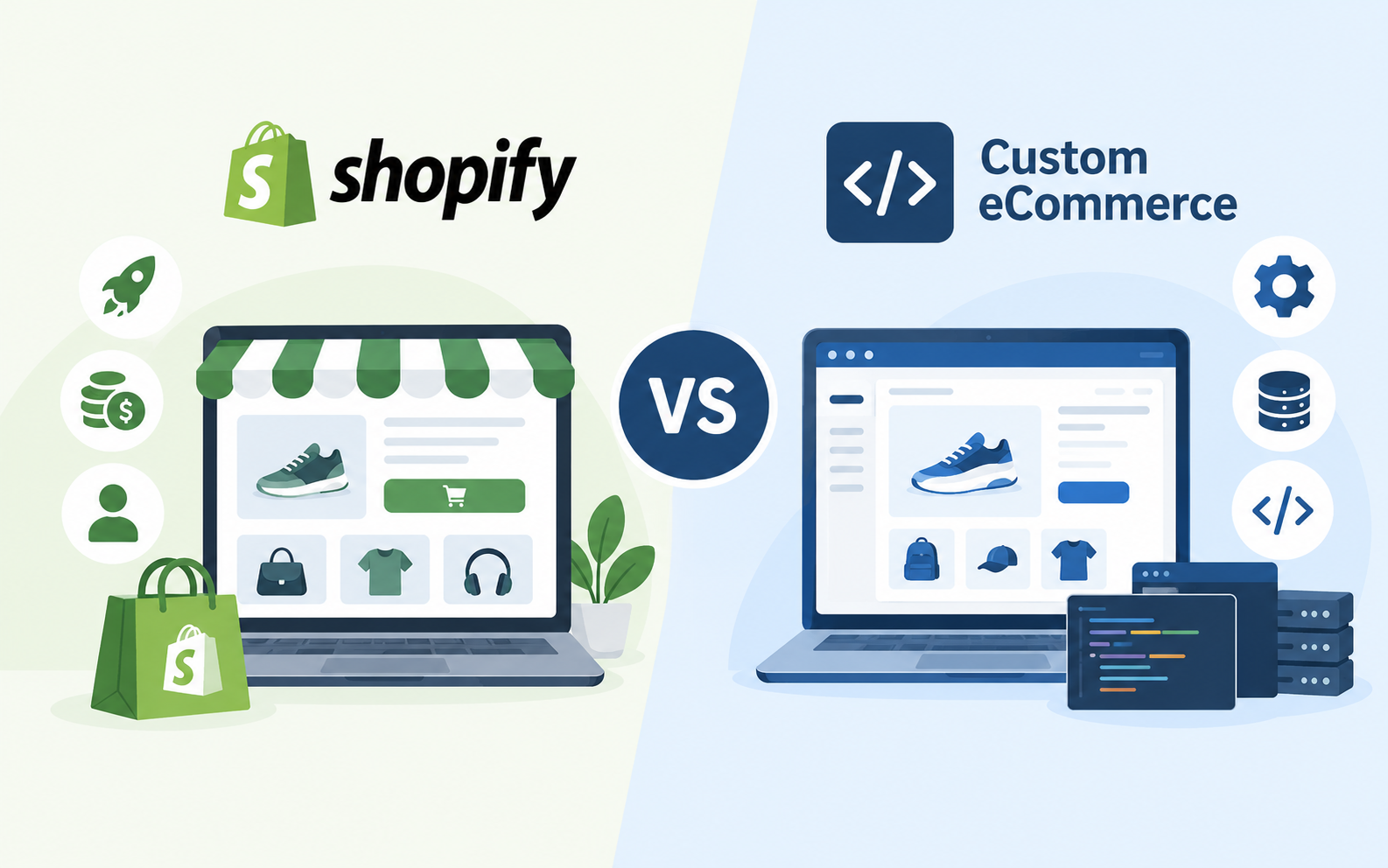
A custom eCommerce website is the better choice if your business has outgrown template-based platforms, needs unique workflows, or plans to scale into a large catalog with heavy traffic. Custom builds cost more upfront, but they remove recurring platform fees and give you complete ownership of the code.
Most businesses starting out should pick Shopify. Businesses with complex operations, large budgets, or very specific technical needs should consider a custom build. The rest of this guide explains why.
What Is Shopify?
Shopify is a hosted eCommerce platform. This means Shopify handles your servers, security, checkout, and payment processing, so you don't need a development team to launch a store.
You pick a plan, choose a theme, add your products, and your store is ready to sell. Shopify also offers a marketplace of more than 8,000 apps for things like reviews, subscriptions, upselling, and email marketing, so you can add features without writing code.
This is why Shopify has become the default starting point for so many new brands. It removes the technical barrier to entry almost entirely. The tradeoff is that you work within Shopify's rules, themes, app ecosystem, and pricing structure.
What Is a Custom eCommerce Website?
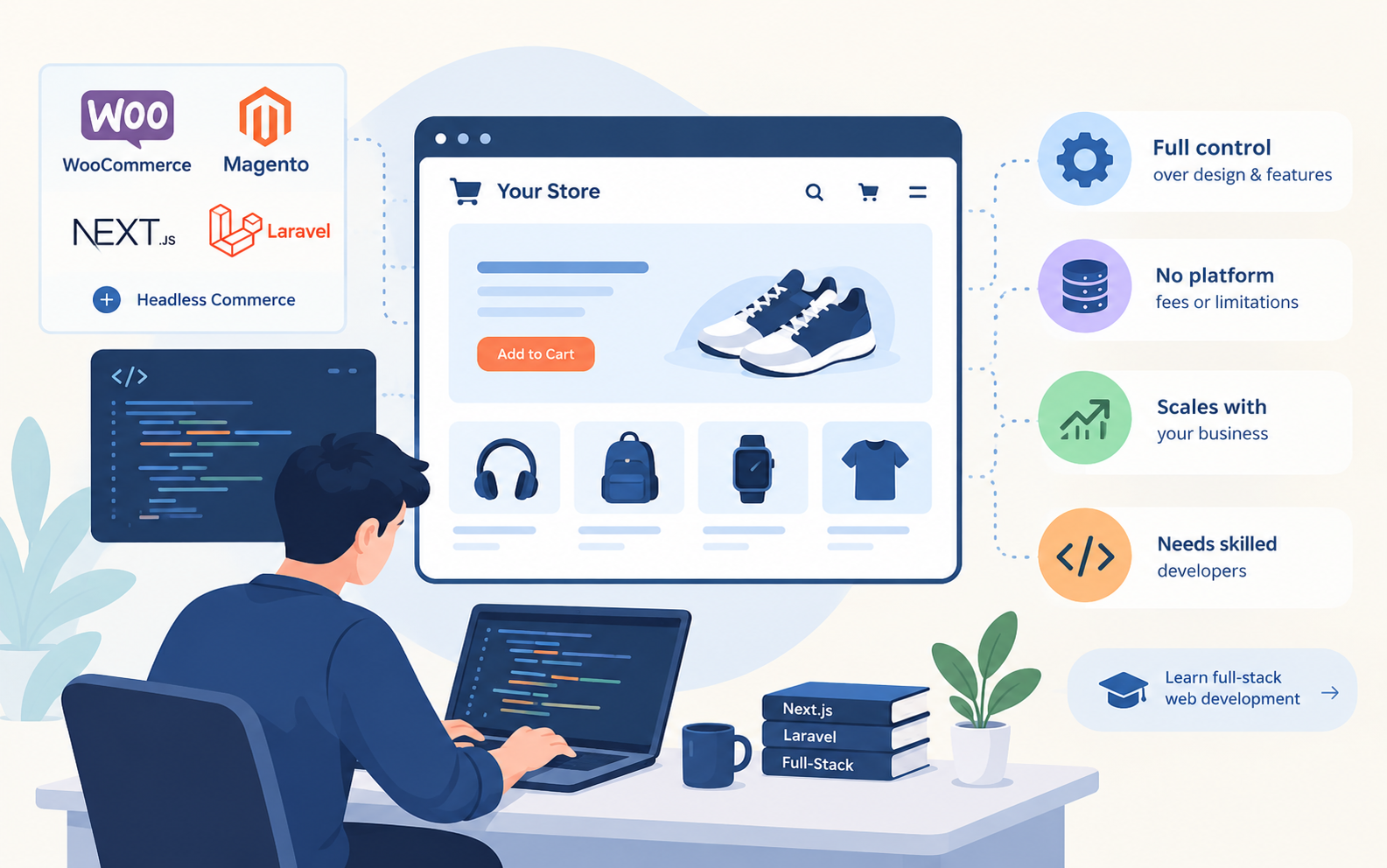
A custom eCommerce website is built from scratch using frameworks and code rather than a pre-built platform. Instead of picking up a theme, a development team designs the store, the checkout flow, the backend systems, and every feature around your exact business needs.
Custom builds are usually created on frameworks like WooCommerce, Magento, or fully bespoke stacks using technologies like Next.js or Laravel, often paired with headless commerce setups that separate the frontend design from the backend logic.
A custom website gives you complete control over how your store looks, works, and grows, without being tied to platform fees or limitations. The tradeoff is that you need skilled developers to build and maintain it.
If you’re a student, joining a full-stack web development course can help you learn how to build complete websites and improve their speed, design, and overall performance.
Shopify vs Custom eCommerce: Full Comparison Table
Here is a side-by-side look at how the two options compare across the factors that matter most.
Factor | Shopify | Custom eCommerce |
Upfront cost | Low, starts around $29 to $79 per month | High, typically $3,500 to $100,000+ depending on complexity |
Speed to launch | 3 to 6 weeks for a standard store | 3 to 6 months or longer |
SEO control | Good, with some platform limits | Full control over structure and code |
Scalability | Strong with Shopify Plus, but tied to platform limits | Unlimited, depends on your infrastructure |
Maintenance | Handled by Shopify automatically | Requires an ongoing developer or team |
Customization | Moderate, through themes and apps | Unlimited, built around your exact needs |
Transaction fees | 0.5% to 2% unless you use Shopify Payments | None |
This table outlines a Shopify vs custom ecommerce website decision, but the real difference shows up when you look closely at cost and performance, which the next two sections cover.
Shopify vs Custom eCommerce Website (Cost Comparison)
Cost is often the biggest factor when choosing between Shopify and a custom eCommerce website. Shopify has predictable monthly pricing, but costs can increase with premium themes, apps, and transaction fees. Custom development requires a higher upfront investment, followed by lower ongoing hosting and maintenance costs.
For small businesses, Shopify is usually more affordable and easier to start with. A custom store can make more financial sense for larger or growing businesses that need advanced features and greater long-term control.
So, the real Shopify vs. custom website cost comparison isn't about which one is cheaper on day one. It is about whether you value a low upfront cost now or lower long-term costs later. Startups usually need the first. Established brands with steady revenue often benefit more from the second.
Cost Factor | Shopify | Custom eCommerce Website |
Initial Cost | Low upfront cost; plans start at around $29/month | Higher upfront investment, typically $3,500–$6,000+ for a basic store |
Monthly Cost | Around $29–$299/month, depending on the plan | Usually $50–$300/month for hosting and maintenance |
Development Cost | Low, as Shopify provides ready-made themes and features | Higher, as design and development are built from scratch |
Apps & Features | Paid apps can add $10–$100+ per month depending on requirements | Custom features are usually included in the development cost |
Hosting | Included in the Shopify subscription | Paid separately based on traffic and hosting needs |
Maintenance | Relatively low because Shopify manages the platform | Higher responsibility for updates, security, and technical maintenance |
Scalability | Suitable for most small and mid-sized businesses | Better for complex, high-volume, or enterprise requirements |
Best For | Businesses looking for a faster and more affordable launch | Businesses needing complete control and advanced functionality |
Long-Term Cost | Recurring subscription, app, and transaction costs | Higher initial cost but potentially lower recurring platform costs |
Speed and SEO: Which Platform Performs Better?
Page speed is no longer just a technical detail. Google uses a set of metrics called Core Web Vitals to measure how fast and stable a page feels to a real visitor, and these metrics directly affect where your store ranks in search results.
The three Core Web Vitals metrics are:
Largest Contentful Paint (LCP): how quickly the main content loads, ideally under 2.5 seconds
Interaction to Next Paint (INP): how quickly the page responds when someone taps or clicks, ideally under 200 milliseconds
Cumulative Layout Shift (CLS): how stable the layout stays while loading, ideally under 0.1
Shopify often performs well out of the box because it controls its hosting infrastructure, but too many apps can slow it down. Custom builds offer more control over speed, SEO, and site architecture, though their performance depends on the development team.
Speed also affects conversions, not just rankings. Shopify is generally a good choice for small and mid-sized stores, while custom builds may suit large catalogs and advanced SEO needs.
Shopify vs Custom eCommerce: Which Fits Your Business Stage?
The right choice depends less on which platform is objectively better and more on where your business currently stands.
Choose Shopify if:
You are launching your first online store and want to move fast
You have a limited budget and no in-house development team
Your product catalog and workflows are fairly standard
You want automatic hosting, security, and maintenance handled for you
Choose a custom eCommerce website if:
You already have steady revenue and a large or complex catalog
You need unique checkout flows, integrations, or backend logic that no platform app can replicate
You want to avoid recurring transaction fees at scale
You have, or plan to build, an in-house or outsourced development team
Weighing the Shopify vs custom website pros and cons this way turns a confusing decision into a practical one. Early-stage businesses rarely need the flexibility of a custom build, and mature businesses often outgrow what a template platform can offer. The goal is to match the platform to your current stage, not to your five-year ambition.
FAQs about Shopify and Custom eCommerce Website
1. Is Shopify good enough for a growing business?
Yes, especially with Shopify Plus, which is built for high-volume stores. Many large brands run successfully on Shopify without ever needing a custom build.
2. Does a custom eCommerce website rank better on Google?
Not automatically. Ranking depends on content quality, backlinks, and technical SEO execution. A custom site gives you more control over these factors, but only if your team uses that control well.
3. Can I switch from Shopify to a custom website later?
Yes, many businesses start on Shopify and migrate to a custom platform once they outgrow it. This is a common and practical path rather than a failure of the original choice.
4. Are Shopify transaction fees avoidable?
Yes, if you use Shopify Payments as your payment gateway, the extra transaction fee is waived. Using a third-party gateway means you will keep the fee.
5. How long does a custom eCommerce website take to build?
A basic custom store can take a few months, while complex builds with advanced features often take four to six months or longer, depending on scope and team size.
6. Which option is cheaper in the long run?
Custom development is usually cheaper after the first one to two years because you remove recurring platform and transaction fees. Shopify is cheaper in the short term because there is little to no upfront development cost.
7. Do I need coding skills to use Shopify?
No. Shopify is designed for non-technical users. You can launch a fully functional store using themes and apps without writing any code.
8. Is a custom eCommerce website more secure than Shopify?
Not necessarily. Shopify handles security, SSL, and PCI compliance automatically. A custom site's security depends entirely on how well it is built and maintained.
9. Can I sell on multiple channels with Shopify?
Yes. Shopify connects to marketplaces like Amazon and social platforms like Instagram and Facebook out of the box. Building the same multi-channel setup on a custom site requires extra integration of work from your development team.
10. Do I need separate hosting for a custom eCommerce website?
Yes. Unlike Shopify, where hosting is bundled into your plan, a custom build needs its own hosting, whether that is shared hosting for a small store or a managed cloud setup for a high-traffic site. This is an extra cost you need to budget.
11. Which option handles high traffic spikes better, like during a sale?
Shopify is built to absorb sudden traffic spikes without extra setup, since it manages server capacity for you. A custom site can handle the same spikes just as well, but only if it is built on solid, scalable infrastructure from the start.
12. Can a small business afford a custom eCommerce website?
It depends on the scope. A simple custom store can start in the low thousands, which is within reach for some small businesses. But most small businesses with limited budgets still find Shopify more practical for getting started.
13. Does Shopify limit how much I can customize my store's design?
To an extent. Shopify themes are flexible, but the platform structure sets limits. If your design vision requires something themes and apps cannot achieve, that is usually a sign that a custom build may serve you better.