
"We have trillions of data points from billions of transactions across millions of merchants. Simply put, we believe we have a more diverse commerce data set than almost anyone else on the Internet. And of course, data is what AI is fueled by." — Harley Finkelstein, President, Shopify
Two shifts are rewriting how Shopify products get found. AI answer engines — ChatGPT, Gemini, Perplexity, Copilot — now sit between shoppers and stores, extracting product data from pages, reviews, and feeds to generate direct answers. Agentic commerce protocols (ACP and UCP) go further — they let those same AI systems complete checkout inside the chat, with Shopify integrated into both.
The shared consequence: one product record now feeds the Shop app, agentic checkout platforms, external AI answer engines, and on-store recommendations — all at once. Design, photography, and store copy sit downstream of that record. If the underlying data is thin, inconsistent, or missing key identifiers, the listing loses visibility across every AI surface simultaneously.
This blog explains the key factors reshaping product discovery on Shopify, the practical steps that make listings eligible for AI surfaces, and how Shopify product listing optimization helps. Let’s begin!
The Structural Shift: Key Factors Redefining Product Discovery on Shopify
1. AI Answer Engines Restructure Product Discovery
53% of shoppers use AI as their primary tool to research products and brands before they click through to a store.
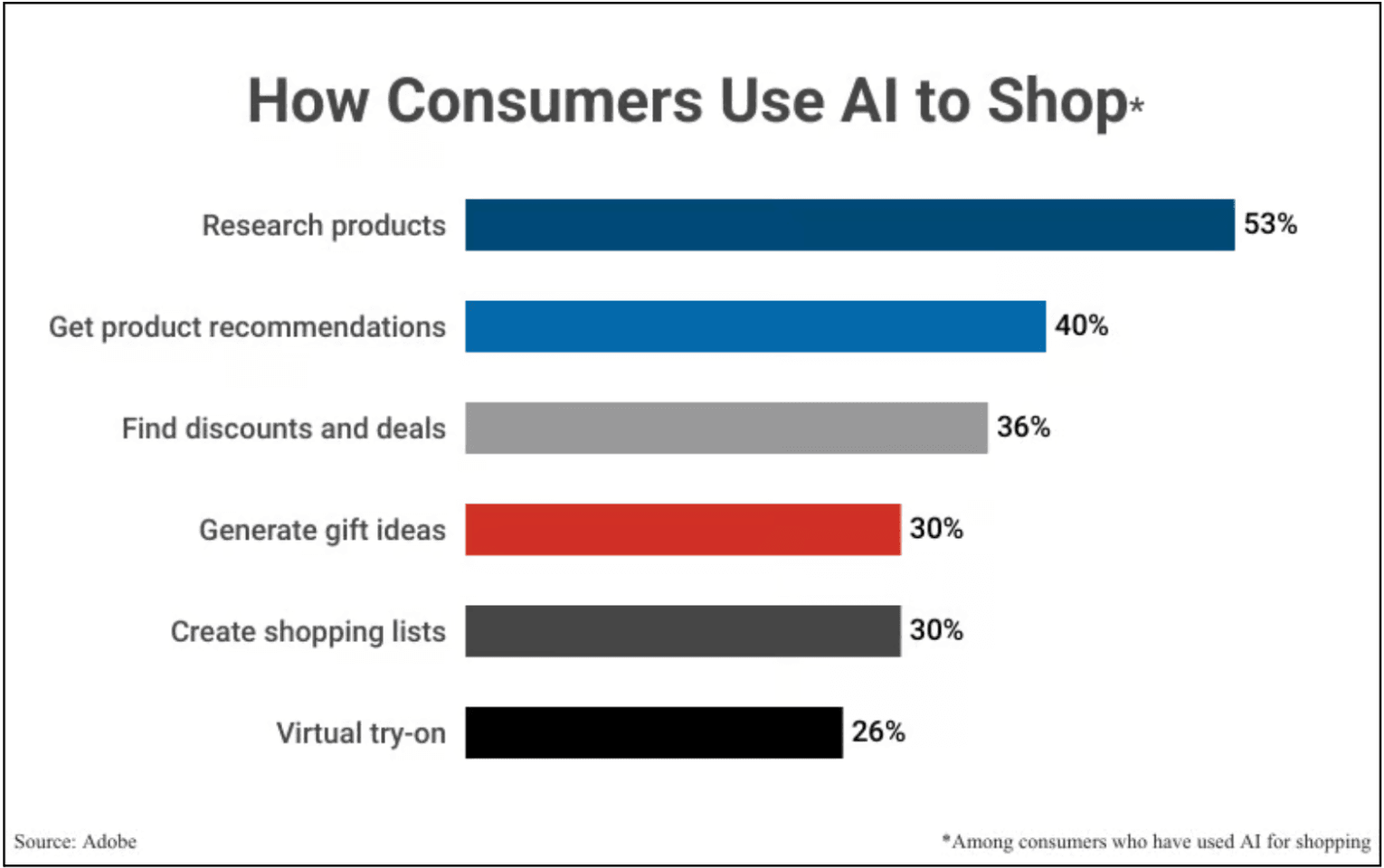
These systems generate contextual answers by extracting information from product pages, reviews, comparison articles, forums, and structured feeds. Shopify AI search optimization now needs to target two distinct ranking systems — Google's traditional index and the retrieval layer feeding AI answer engines.
2. Agentic Commerce and the Universal Commerce Protocol
Beyond research, a second shift goes further: shoppers can now complete purchases entirely within the AI chatbot.
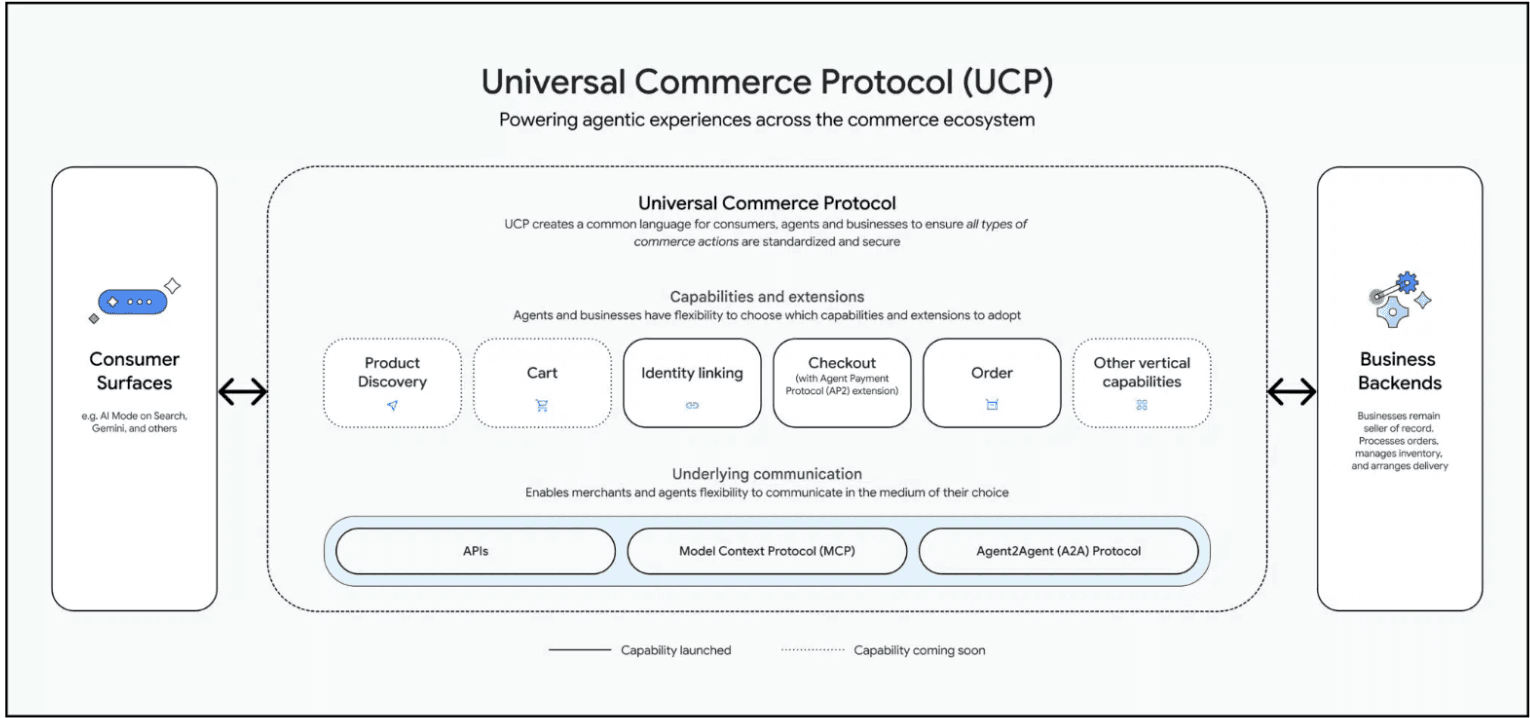
Two protocols power this shift, and Shopify is integrated with both. It was a launch partner for ChatGPT Instant Checkout and Microsoft Copilot Checkout — both built on ACP (Agentic Commerce Protocol). It also co-developed UCP (Universal Commerce Protocol) with Google, Walmart, Target, Etsy, and Wayfair, which powers shopping inside Google AI Mode and Gemini.
The protocols allow agents to search, compare, apply discount codes, and complete checkout — all from within the chat interface.
What this means for Shopify merchants: Product Data is the Driving Factor Behind Ranking:
‘When AI agents shop, data becomes your storefront.’ –-Forbes
When an AI agent surfaces a product — inside ChatGPT, Copilot, Gemini, or Google AI Mode — the shopper sees the data the agent pulled from the product record: title, description, attributes, price, availability, and reviews. Design, photography, and on-store copy sit downstream of that record.
Catalog Completeness Determines Eligibility: Every AI surface — ChatGPT, Copilot, Gemini, Google AI Mode — requires the same core product data to rank a listing: GTIN or MPN, brand, title, description, price, and availability. Products missing any of these are filtered out before ranking begins.
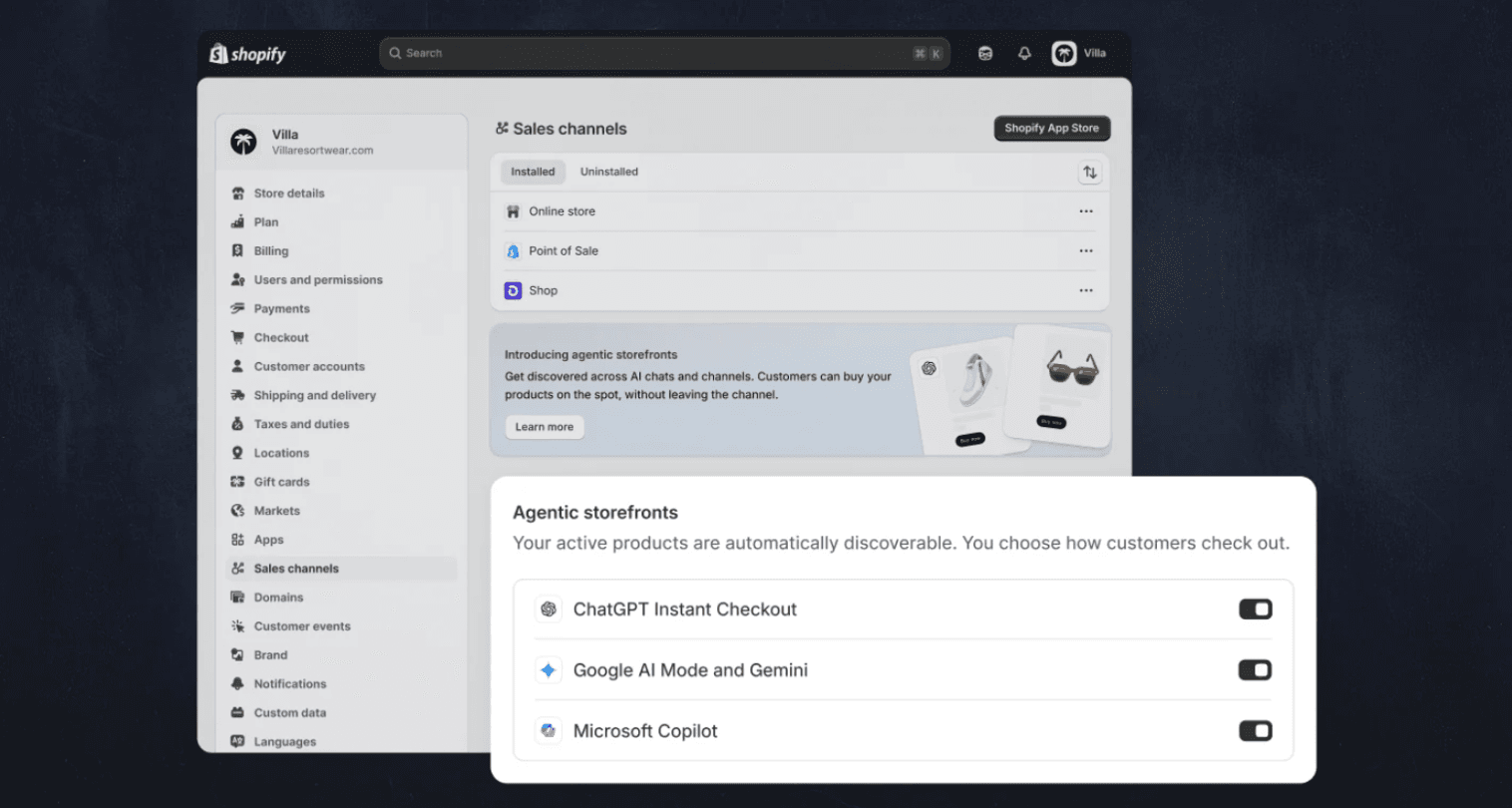
Merchant Control Sits in Agentic Storefronts: Shopify gives merchants a single admin panel to decide which products appear on which AI surfaces, or to exclude a channel entirely. Default behavior varies by plan and region.
II. How to Optimize Your Shopify Listings for AI Search and Recommendations
1. Implement Complete Structured Data and Schema Markup
Structured data lets AI systems extract product details — price, availability, SKU, brand, ratings — without interpreting natural language.
Most modern Shopify themes, including Dawn, auto-generate basic Product schema in the product template's Liquid code. The gap sits in the optional schema types that drive rich results and give AI search systems clearer product context:
→ Product, Offer, and AggregateRating — baseline, but often missing priceValidUntil, gtin, mpn, and brand
→ Review — usually added via a review app (Judge.me, Loox, Yotpo) that injects additional JSON-LD
→ FAQPage — supports direct inclusion in Perplexity and ChatGPT query answers
→ BreadcrumbList — strengthens entity disambiguation for AI crawlers parsing category context
2. Structure Product Content for AI Retrieval
AI agents like ChatGPT, Perplexity, and Gemini favor natural language that answers specific buyer questions — not fragmented keyword strings stuffed into product descriptions.
Titles and descriptions should reflect how people actually speak about the product. Here’s how;
→ Match Descriptions to Search Intent — Write descriptions that naturally reflect long-tail queries by covering the product’s use case, intended buyer, and practical advantages, not just a list of features. For example, instead of broad terms like “wool shirt,” shoppers search for phrases such as “merino wool base layer for winter hiking.”
→ Context-Driven Framing — Explain how the product fits into a customer's lifestyle, or use case. For instance, a backpack used by a bike commuter reads differently from the same backpack used by a university student.
→ Scannable Structure — Structure product content with short paragraphs, bullet points, and clear subheadings so it is easier for AI systems to interpret and retrieve.
→ Dedicated FAQ Section on Product Pages — Addresses common queries directly and matches conversational search patterns to get cited in AI-generated answers.
3. Build Trust Signals That AI Systems Cite
AI answer engines — ChatGPT, Gemini, Perplexity, Copilot, and Google AI Mode — weigh brand credibility when deciding which products and merchants to surface. Google introduced this as the E-E-A-T framework (Experience, Expertise, Authoritativeness, Trust), but the same signals drive citation decisions across every major retrieval layer.
-
Verified customer reviews at scale — a product with 400 reviews and detailed user-submitted photos is more likely to be recommended than one with 20 generic five-star ratings. Structured review prompts (fit, use case, comparison) generate review text AI systems score as high-information input.
-
Transparent sourcing and certification claims — explicit details on materials, country of origin, certifications (GOTS, Fair Trade, B Corp, USDA Organic). These map to buyer queries like "where is this made" and "is this certified organic."
-
Policy clarity — returns, shipping, warranty, and customer service policies written in plain language. AI agents pull directly from policy pages when shoppers ask procedural questions inside ChatGPT or Copilot checkout flows.
-
Consistent brand footprint — standardized information across the store, social channels, and third-party directories reinforces brand legitimacy in retrieval systems.
4. Technical Optimization for AI Crawlers
AI crawlers — GPTBot, PerplexityBot, ClaudeBot, Googlebot — treat slow, fragmented, or error-prone stores as lower-quality sources.
Five technical checkpoints for Shopify AI search optimization:
-
LCP (Largest Contentful Paint) under 2.5 seconds — Core Web Vitals affect both Google ranking and AI retrieval weighting. Shopify's Web performance reports highlight the underlying issues; most LCP failures trace back to oversized hero images, render-blocking apps, or theme bloat from unused sections.
-
Clean, descriptive URLs — product handles should reflect the product name (/products/leather-messenger-bag-commuter rather than /products/prod-48291). Every URL change without a 301 redirect costs indexing authority.
-
Crawler access configuration — review robots.txt to confirm AI crawlers are allowed where intended. Shopify's default robots.txt can be customized via robots.txt.liquid for granular control.
-
High-resolution imagery with descriptive alt text — minimum 2048×2048 pixels for primary images, clean backgrounds, intent-based alt text. Shopify's CDN compresses uploads, so start with source files larger than the final display size.
5. Use Shopify Magic and Search & Discovery as Leverage Tools
Shopify Magic generates product descriptions, email copy, and alt text from minimal input. Use it for baseline drafts, then layer in category-specific positioning and fact-checking before publishing.
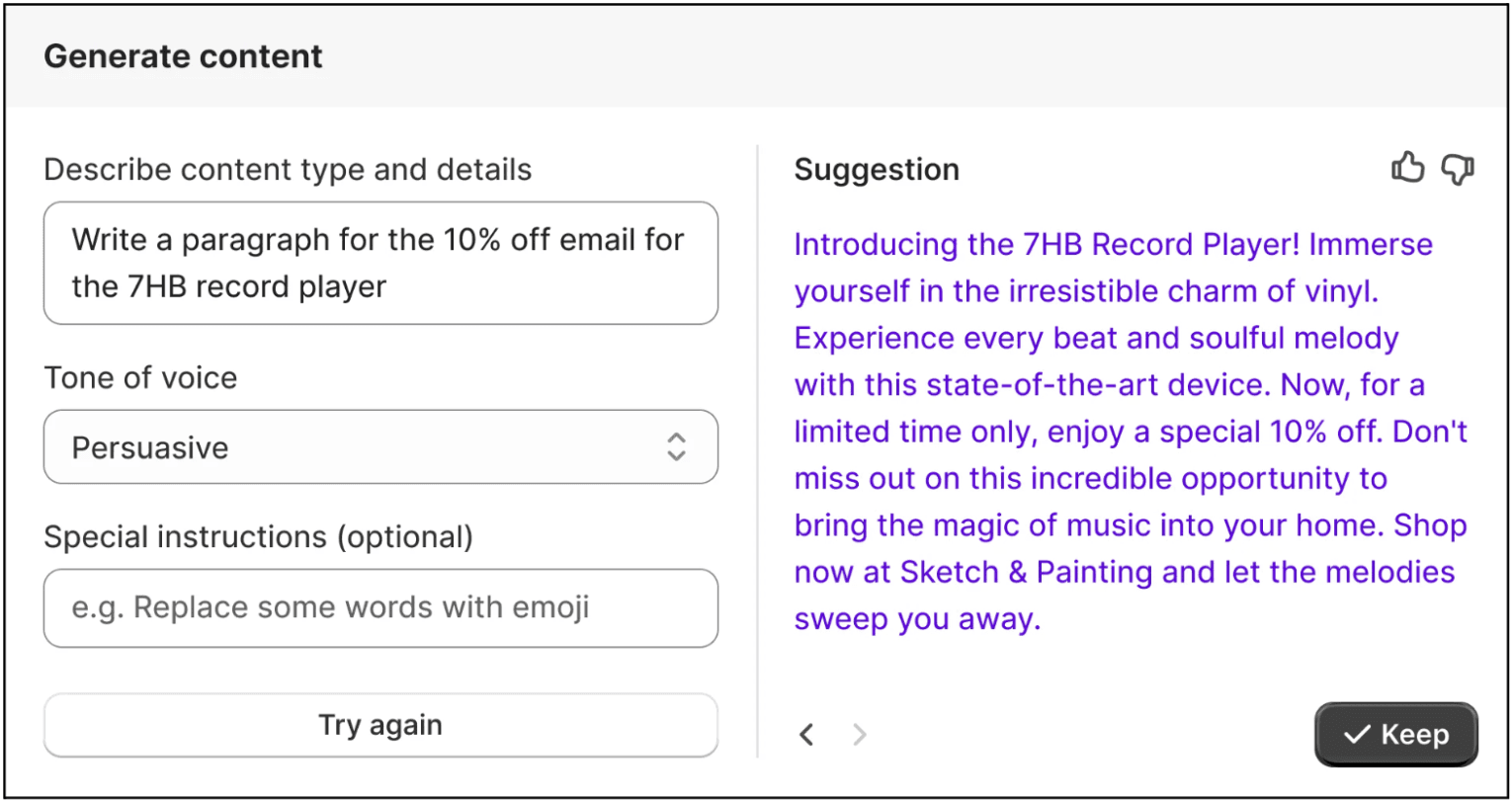
Shopify's free Search & Discovery app controls on-site search, filtering, and recommendation behavior. Four settings directly affect AI-driven on-store recommendations:
→ Synonyms — map industry terms to shopper terms ("sneakers" and "trainers," "sofa" and "couch"). Without synonym groups, matching products get filtered out of relevant queries.
→ Product boosts — promote high-margin or strategic products when they surface in eligible search results.
→ Product recommendations — configure complementary and related products shown on product detail pages, directly shaping cross-sell and upsell paths.
Filter configuration — expose metafields as shopper-facing filters, strengthening both UX and the recommendation model's understanding of product attributes.
6. Maintain Clean Product Feeds to External AI Surfaces
Shopify's Sales Channels framework automatically syncs product data to Google Merchant Center, Meta Commerce Manager, TikTok Shop, and the Shop app. AI retrieval systems increasingly ingest this feed data upstream, which means feed quality directly affects eligibility on external AI surfaces.
Three fields to audit across every product:
-
GTIN, MPN, and brand — must be populated for eligibility on most AI surfaces. Missing identifiers are the most common reason products get disapproved in Google Merchant Center.
-
Google product category — map to the closest taxonomy node, not a generic parent. Specific categorization improves both Merchant Center approval and AI system comprehension of the product's context.
-
Availability and price — must update in real time. Shopify handles this natively on most setups, but custom implementations and headless builds frequently lag.
The Strategic Imperative: Shopify gives merchants the infrastructure. Translating that infrastructure into consistent AI surface visibility — across schema, content, trust signals, technical hygiene, off-site authority, and product feeds — requires operational discipline that compounds over time.
For merchants managing catalog depth, multi-channel selling, and active promotion simultaneously, schema maintenance, content refresh cycles, feed compliance monitoring, off-site citation building, and continuous crawler audits each demand specialization and bandwidth that most in-house teams cannot sustain at the required cadence.
Shopify product listing optimization services bring the field-level expertise and technical infrastructure to close that gap — identifying eligibility gaps early, connecting signals across AI surfaces, and converting them into listing-level changes before they compound into lost visibility.