

The first international orders arrive without any decision being made. Someone in Germany finds you through a search, buys, and tells a friend. Six months later Germany is 8% of revenue and you have never once thought about it deliberately.
The obvious response is to localise the store. Currency, language, local payment methods, a shipping option that does not quote four weeks. That work is well understood and your developers can scope it.
The part that catches brands out is everything sitting behind the storefront, because serving a market properly means people, logistics and paperwork rather than a translated checkout.
I. When a market stops being incidental

There is a difference between receiving orders from a country and selling into it. The line is usually crossed when three things happen at once.
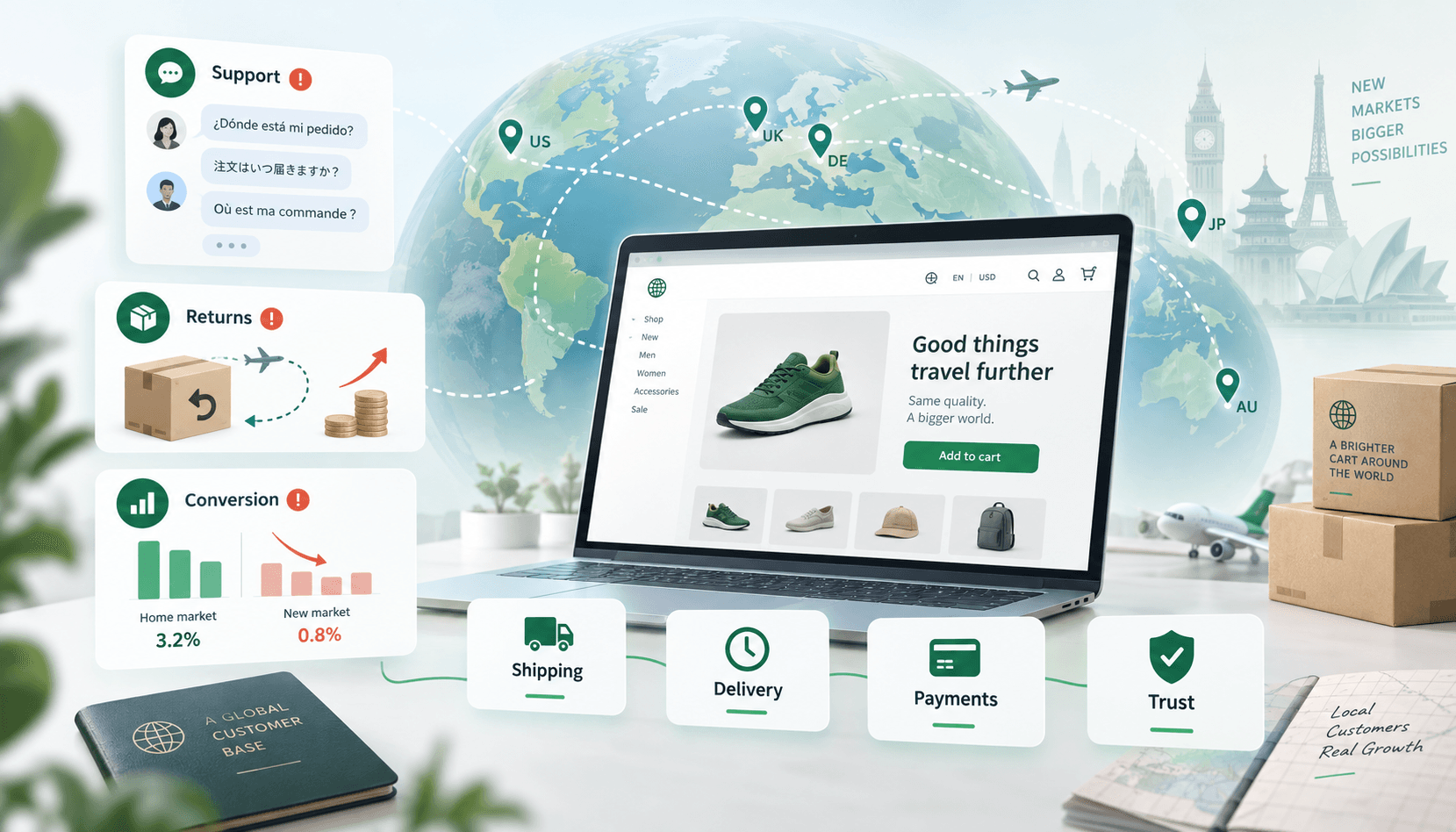
Support tickets start arriving in another language, and translation tools stop being good enough for anything involving a return or a complaint. Returns become frequent enough that your address in another country starts costing real money. And your conversion rate in that market sits noticeably below your home rate, which almost always means something in the experience is wrong rather than the demand being weak.
That third signal is the useful one, because it is measurable. If a market converts at half your domestic rate on similar traffic quality, the gap is usually shipping cost, delivery time, payment method or trust. All four are fixable, but not by translation alone.
II. The storefront layer, and what usually gets missed
On Shopify, most of this is configuration rather than development. Shopify Markets lets you run several countries from one store and one admin, with market-specific pricing, localized domains, currency and language, so you are not duplicating the catalogue into a second storefront and maintaining both. A second store is worth it only when the markets genuinely differ, usually a different catalogue, a separate legal entity or a regulatory split.
Currency and language come first. With Shopify Payments, customers can be charged in their own currency rather than being asked to mentally convert, and per-market price rules let you round to something that looks deliberate instead of an exchange rate artefact. Translate and Adapt covers storefront translation, though the machine output needs overriding on product copy and anything legal. Local payment habits matter just as much: Klarna in Germany and Sweden, iDEAL in the Netherlands, and card-only checkouts that quietly lose customers in markets where cards are not the norm.
Market catalogues are underused. Shopify lets you control which products appear in which market, which is useful when licensing, compliance or shipping restrictions mean a line cannot be sold everywhere. Hiding it in that market is better than a customer discovering the restriction at checkout.
Trust signals are the other half, and they are cheaper to fix than most brands assume. A local address in the footer, prices shown inclusive of tax where that is the local convention, reviews from customers in that market rather than only your home one, and a returns policy stated in local terms. Each is small. Together they move conversion in markets where an unfamiliar foreign brand starts from a deficit.
The item that gets missed most often is landed cost. If a customer sees one price at checkout and then gets a demand for duties and handling fees at the door, you have created a refund and bad review at once. Shopify Markets can calculate and collect duties and import taxes at checkout so the buyer sees the full cost upfront, which is one of the highest-return changes a cross-border store can make.
The decision underneath that setting is who the merchant of record is. On standard Markets it stays you, which means tax registration, duties and customs compliance remain your responsibility. Managed Markets puts Global-e in that role for a per-order fee, guarantees the duty and tax amounts shown at checkout, and ships delivered duty paid. It also folds duties, import taxes and fees into the displayed product price rather than adding separate lines at checkout, which tends to read better to buyers even though the total is the same.
The rules here are also moving, which affects that choice. The European Commission has agreed to remove the EUR 150 customs duty exemption for parcels from outside the EU, so the low-value shipments many brands built their cross-border pricing around will start attracting duty. Whichever setup you use, the duty question stops being optional at that point.
III. Fulfilment and returns
Shipping everything from your home warehouse works until delivery times or return costs make the market uneconomic.
Before moving stock, work out the actual cost per order in that market. Not the shipping rate, the whole thing: pick and pack, carriage, duties if you absorb them, payment processing at local rates, and returns as a percentage of orders rather than as an exception. Brands are often surprised to find a market that looks like 8% of revenue is contributing almost nothing to margin once returns are counted properly.
The usual progression is a local 3PL once volume justifies it. Faster delivery, cheaper returns, and a local address that improves conversion on its own. The trade-off is inventory split across locations, which means either holding more stock overall or accepting stockouts in one place while the other has plenty.
Returns deserve their own thinking. Cross-border returns that route back to your home country cost more than the item is worth surprisingly often. A local returns address, a consolidation arrangement, or a policy that refunds low-value items without requiring the return can all be cheaper than the default.
Decide this before you promote heavily in a market. Discovering your return economics during a Black Friday spike is an expensive way to learn them.
IV. Support coverage is a people problem
Tooling vendors will tell you that a good helpdesk and AI triage solve international support. They help with volume. They do not solve language nuance or time zones.
A customer in Germany writing about a warranty issue wants an answer in German from someone who understands the local consumer protection rules. A customer in Singapore wants a reply during their working day. Neither is a software problem.
That leaves the question of how those people are engaged. Most brands start with a staffing agency, which supplies workers who remain employed by the agency, or with an employer of record, where a provider employs the person locally on your behalf while they work as part of your team. The distinction matters more than it sounds, because it determines who carries the employment relationship, who the person feels they work for, and how much continuity you get from one season to the next.
There is a practical dimension too. Agency arrangements are quick to start and quick to stop, which is exactly what you want for a six-week peak and exactly what you do not want for a role you are still filling three years later. Employment through a provider takes longer to set up and carries notice obligations, which is the price of keeping someone permanently.
For a genuinely temporary peak, agency staffing is often the pragmatic answer. For a market you intend to keep serving, the continuity argument usually wins, because a support agent who has been answering your customers for two years is worth considerably more than one who arrives every November.
V. The people talking to your customers need to know your catalogue
 Whichever route you choose, the training problem is yours and it does not go away.
Support staff need your product range, your returns policy, your tone, your escalation rules and the twenty questions customers actually ask. In a seasonal operation you teach this to a new group every year, usually in a rush, usually a week before volume arrives.
The cost of getting it wrong is quiet rather than dramatic. There is no incident, just slightly worse answers, slightly longer handling times and a refund rate that creeps up because agents give round rather than explain the policy correctly. None of that appears on a dashboard labelled as a training problem.
Most brands do it with a shared document and a two-hour call. The document ages badly, nobody knows which version is current, and the quality of the answer a customer gets depends on which colleague the agent happened to sit next to.
The alternative is treating it as a course rather than a briefing. Build the catalogue module, the returns walkthrough and the tone guide once, assign them to each new intake, and record who finished what. That is what training management software is built for, and it is the difference between knowing the agent handling a German warranty claim in November was shown the policy and hoping they were. Next year's group then starts from what this year's group learned instead of from a blank page.
The compounding effect is the real argument. A catalogue module written once and updated each season is a small annual task. Rebuilding the onboarding from memory every year is a large one, and it produces worse answers to customers.
VI. Deciding the order
Most brands try to do all of this at once and stall. A better sequence exists.
Fix landed cost and payment methods first, because they change conversion immediately and cost the least. Then look at delivery times, since that's usually the second biggest gap. Only after those two are settled does local fulfilment make sense, because a 3PL amplifies whatever economics you already have rather than repairing broken ones.
Support and staffing come when volume makes the current arrangement visibly strained, which is usually earlier than founders expect and always later than they plan for. Training infrastructure comes with it, not after it.
A localised storefront is the entry ticket to a market. What determines whether the market is worth keeping is everything that happens after the customer clicks buy.