
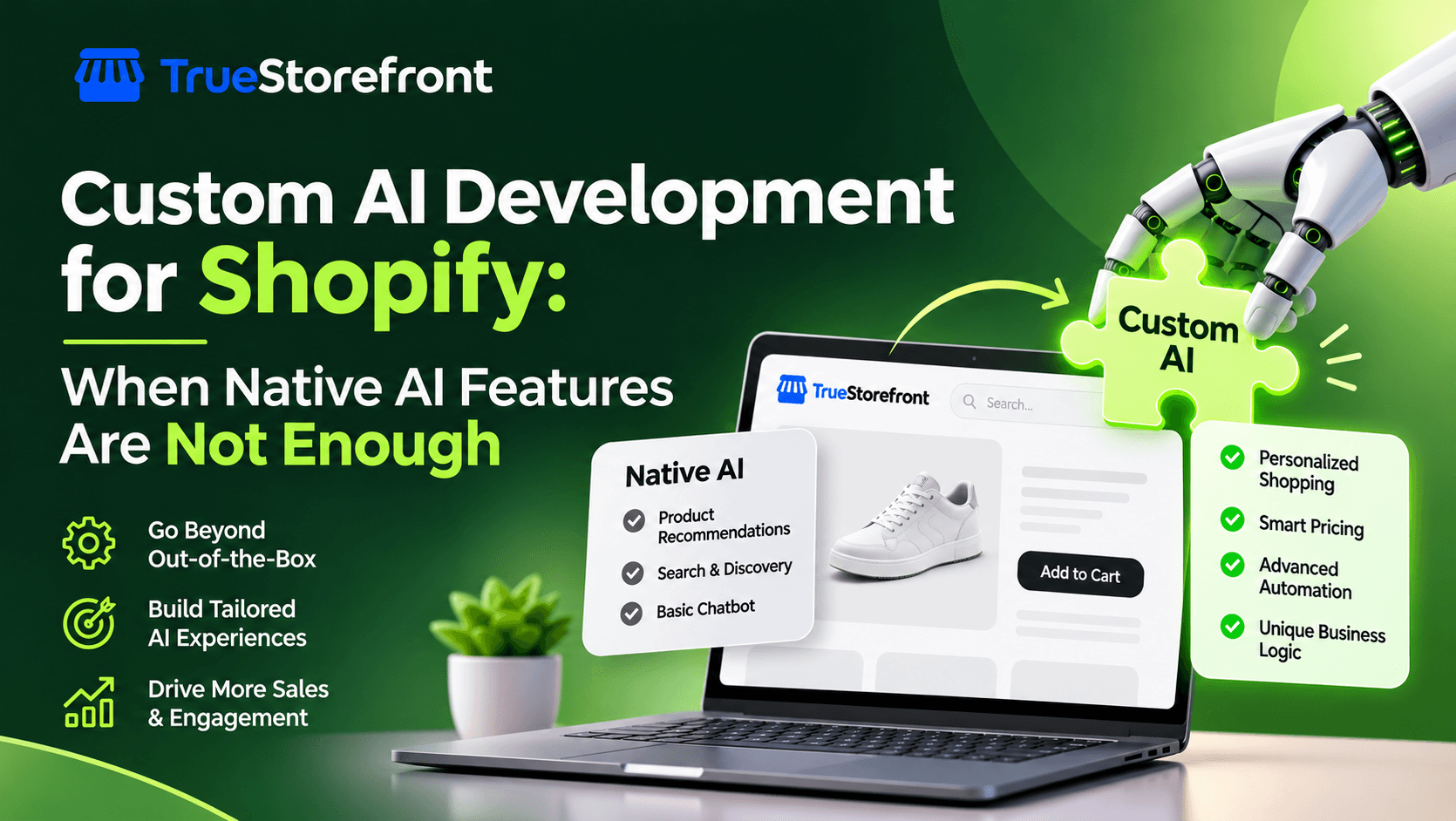
Native admin tools stall quickly. Built-in assistants write quick product descriptions or basic sales summaries, but high-volume stores demand direct database connections across complex operational software. Default tools hit walls. Scaling your store requires Custom AI Development for Shopify to connect separate software platforms and execute automated workflows. Rigid features break under pressure. Custom software delivers specialized AI solutions that manage inventory, support, and sales logic without manual intervention.
Where Built-In Shopify AI Tools Break Down
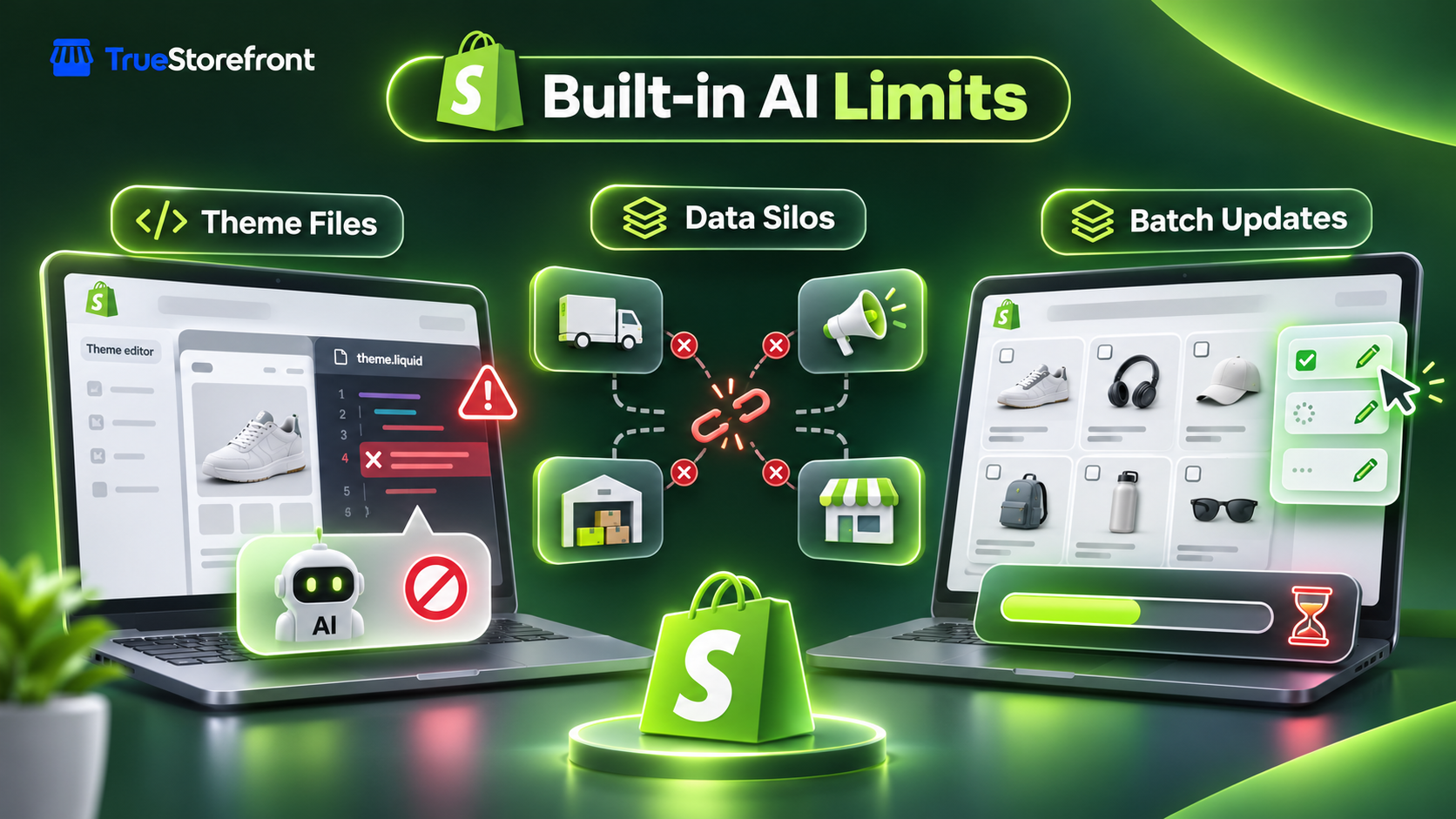
Here’s where the truth comes out. Default store assistants look convenient on paper during initial setup. Ask them to edit a custom homepage section or fix a broken Liquid code template, and they stop cold. They cannot touch theme files.
That limitation creates friction. Merchants expecting automated site adjustments end up editing theme code manually in the theme editor. Theme editing breaks. Default tools generate unoptimized Liquid code that degrades site performance and creates layout glitches across store pages.
Siloed data hurts operations. Built-in software reads standard store records and ignores external shipping platforms, ad platforms, and warehouse databases. External platforms stay dark. Managing a store across five separate tools leaves default assistants making blind guesses without access to full operational records.
Batch updates fail. Updating catalog copy with native options forces staff to click into each product page, generate text, and save manually. That takes endless hours. Large product catalogs require automated processing scripts rather than single-shot button clicks inside the admin panel.
Real Practical Roadblocks Merchants Face Daily
Customer Support Bottlenecks and Half-Answers
That’s the mistake to avoid. Assuming built-in chat software handles customer inquiries smoothly often leads to broken support tickets and angry buyers. Native agents lack context. They query product titles and shipping FAQs and ignore past support history, internal team notes, and third-party logistics data.
Unresolved tickets pile up. When a buyer asks about custom order modifications, native chat agents give generic responses before punting the ticket to humans. Support teams remain completely overwhelmed. Integrating external help desks and technical documentation requires custom engineering from an AI/ML Development Company to give agents full contextual operational history.
Catalog Scaling Disasters and Metadata Cleanup
Catalog updates stall at scale. Merchants managing thousands of items discover that native tools cannot process batch catalog updates across external inventory systems. Brand tone suffers heavily. Standard generators produce repetitive text that dilutes brand identity and fails to highlight specific product specifications for search engines.
Custom scripts fix bottlenecks. Specialized data pipelines parse raw supplier spreadsheets, extract technical attributes, and push structured product listings directly into backend databases. Manual entry disappears completely. Merchants publish hundreds of product pages in minutes and maintain strict brand guidelines across every listing.
Dynamic Merchandising and Recommendation Limits
Default recommendations waste margins. Standard recommendation blocks display items based on basic co-purchase patterns without evaluating current inventory levels or item profit margins. Low-margin merchandise gets promoted repeatedly. Custom machine learning models re-rank product recommendations dynamically to maximize overall basket value and clear slow-moving inventory.
Rule-based recommendation systems fail. Static store scripts suggest items based on outdated purchase categories rather than evaluating active browser behavior during live customer sessions. Buying intent shifts constantly. Real-time machine learning algorithms adjust product feeds instantly, matching recommendations to exact buyer requirements and lifting conversions.
Engineering Custom Machine Learning Workflows for Shopify
Here’s where real engineering begins. Custom applications link directly to Shopify through GraphQL APIs, processing complex algorithms on dedicated cloud servers without slowing storefront rendering. Store performance remains fast. Offloading heavy data tasks allows custom algorithms to analyze shopper behavior without creating technical lag on mobile devices.
Vector databases supply long-term memory. Unstructured documents, warehouse guides, and historical support tickets convert into vector embeddings that allow AI models to fetch exact context instantly. Search latency drops dramatically. Shoppers get immediate, accurate answers to complex product questions without waiting for human agent review.
Be skeptical of unverified claims. Testing unproven software on live store visitors leads to incorrect policy statements and frustrated shoppers who leave without purchasing. Simulation testing prevents mistakes. Top AI/ML companies run proposed models through thousands of historical support tickets to measure accuracy before deploying live agents.
Autonomous execution handles real work. Custom agents do far more than draft text; they trigger webhooks to update shipping records and process dynamic return approvals. Manual administration disappears fast. Partnering with a skilled AI app development company gives merchants custom automation that manages store operations reliably.
The Business Case for Custom E-Commerce AI
Area | Standard store tools | Custom machine learning | Why it matters |
Customer support | Mostly human-handled tickets | Automated handling of routine inquiries like tracking and returns | Lower cost per interaction, and agents free for complex cases |
Inventory planning | Manual spreadsheet estimates | Demand forecasts learned from past buying patterns | Less overstock and fewer stockouts |
Pricing | Static catalog rules | Adjustments based on demand and competition | Better margin protection, with results varying by category |
Recommendations | Basic “bought together” widgets | Personalized suggestions per session | Recommendations can drive up to about 31% of site revenue |
Shopper guidance | Browsing and search only | Conversational assistants that answer product and delivery questions | Fewer shoppers leave over unanswered questions |
Making the Shift to Custom Machine Learning Infrastructure
The practical path starts with data. Machine learning models rely on clean order logs, structured product attributes, and accessible API endpoints to generate reliable predictions. Unorganized data causes failures. Fixing internal product catalogs and database records forms the foundational step before writing custom code.
Target high-friction operational bottlenecks first. Identify workflows where manual labor drains staff time, like catalog tag cleanup or routine shipping inquiry responses. Fix single problems first. Building a bounded automation workflow proves financial return before committing capital to wider platform integrations.
Demand live sandbox system tests. Require prospective development partners to run pilot demonstrations using actual order histories and product lists rather than pre-recorded sales demos. Staging tests prove value. Replacing standard default utilities with custom machine learning infrastructure gives growing stores a durable operational advantage.
When Custom AI Isn’t Worth It Yet
Custom development isn’t the right call for every store. If you carry a few dozen products, get a handful of support tickets a week, and run everything inside Shopify, the built-in tools plus a few well-chosen apps from the Shopify App Store will probably do the job at a fraction of the cost.
Custom work starts to make sense when the same manual task keeps eating hours, when your data sits in several systems that don’t talk to each other, or when an off-the-shelf app almost fits but keeps getting in the way.
Here’s a simple test. Write down the task, how often it happens, and how long it takes. If you can’t describe the problem in a couple of sentences, you’re not ready to brief a developer. Get that clarity first, and the project will be cheaper, faster, and much easier to judge once it’s live.
I made no factual claims here beyond general advice, so there’s nothing to verify. The only specific reference is the Shopify App Store, which is a real, long-standing marketplace.
Conclusion
Shopify’s built-in AI is fine when you’re small. Once you’re juggling thousands of products, a help desk, and a separate shipping platform, it starts to feel like a tool that can’t see most of your business.
You don’t have to rebuild everything. Clean up your data, pick the one workflow that eats the most staff time, and make any developer prove it works on your real orders before you commit more budget.